
Senatorum Imperialis
| Senatorum Imperialis | |
|---|---|
| Council chamber and seat of government | |
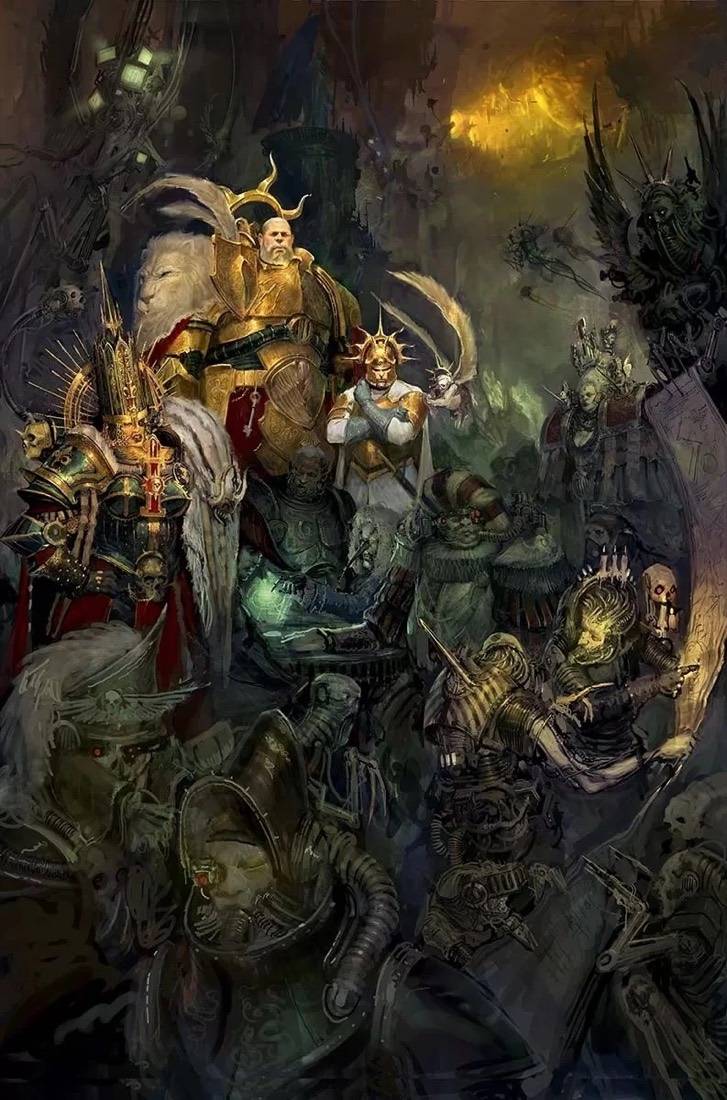 The primarch Roboute Guilliman among the High Lords in the Senatorum, early M42 Artwork © Games Workshop | |
| Overview | |
| Established | Early in the Time of Rebirth, under the regency of Roboute Guilliman; first known full roll in 544.M32 |
| Formal title | Lords Temporal, Martial and Ecclesiarchical of the Most Divine and Righteous Imperium of Mankind |
| Size | Twelve: nine permanent seats and three that rotate |
| State | Imperium of Mankind |
| Leader | Chair, with the titles Lord Commander of the Imperium and Imperial Regent, when the office is filled |
| Governing body | The High Lords of Terra (the High Twelve) |
| Seat | Imperial Palace, Terra |
| Predecessor | Council of Terra (M30–014.M31); Grand Council of Reconstruction (014.M31) |
| Clerk | Chancellor of the Imperial Council |
| Description | Council chamber of the High Lords of Terra |
| Notable events | |
| Beheading (546.M32); dissolution by Goge Vandire (c. 378.M36); return of Guilliman (999.M41) | |
| High Lords of Terra Chancellor of the Imperial Council Imperial Palace | |
The Senatorum Imperialis is the council of the High Lords of Terra and the chamber in the Imperial Palace on Terra in which they sit. In High Gothic the name belongs to the council itself, which is also called the High Twelve and styled, in its full and official form, the Lords Temporal, Martial and Ecclesiarchical of the Most Divine and Righteous Imperium of Mankind. It is made up of the twelve highest officers of the great Adepta of the Imperium of Mankind, and as a collective oligarchy it rules the Imperium in the name of the Emperor of Mankind. Nine of its seats are permanent and three are held in turn by other offices.[1][2]
Its task is to interpret and carry out the Emperor's will. Since the Emperor can no longer rule directly from the Golden Throne, the High Lords hold that his immortal will is known to them and that he rules through them. The Imperium is too vast to be governed centrally in any effective manner, but the High Lords make decisions that affect the lives of trillions. On their command the fleets and armies move, only their edict can approve the Founding of new Space Marine Chapters, and on their order the Black Ships sail and their grim tithes are collected. At different times the council has been led by a chair who is first among equals under the titles of Lord Commander of the Imperium and Imperial Regent. The present holder is the primarch Roboute Guilliman.[1][3]
The Senatorum Imperialis descends from the civil councils of the Unification Wars and the Great Crusade, and it took its present form in the aftermath of the Horus Heresy under the first regency of Guilliman. Its chamber has seen some of the gravest events in Imperial history: the murder of the High Lords in the Beheading of 546.M32, the dissolution of the council by Goge Vandire in the Age of Apostasy, and the return of Guilliman in 999.M41. A notable feature is that no Adeptus Astartes officer has a seat by right, a custom that Guilliman himself is believed to have fixed.[3][4][1]
Name and nature
[edit]The High Lords of Terra article describes the twelve members and their offices. This article treats the Senatorum as an institution: the body that holds the Emperor's authority in his absence. It is an oligarchy, a collective of the leaders of the most powerful Adepta, and it has ruled the Imperium in that way through most of Imperial history.[1][2]
Since the dark days of the Horus Heresy the number of seats has largely stayed the same, fluctuating in crises before returning to twelve. Each seat is held by the leader of one of the most powerful Adepta and other organisations of the Imperium. A complex web of tradition, skulduggery, promises of support, threats of retaliation and mutual interest decides who holds a seat and who does not, and the sitting members take pains to see that their own seat stays permanent, so that on their death the post passes to the new head of their organisation.[1]
The chamber
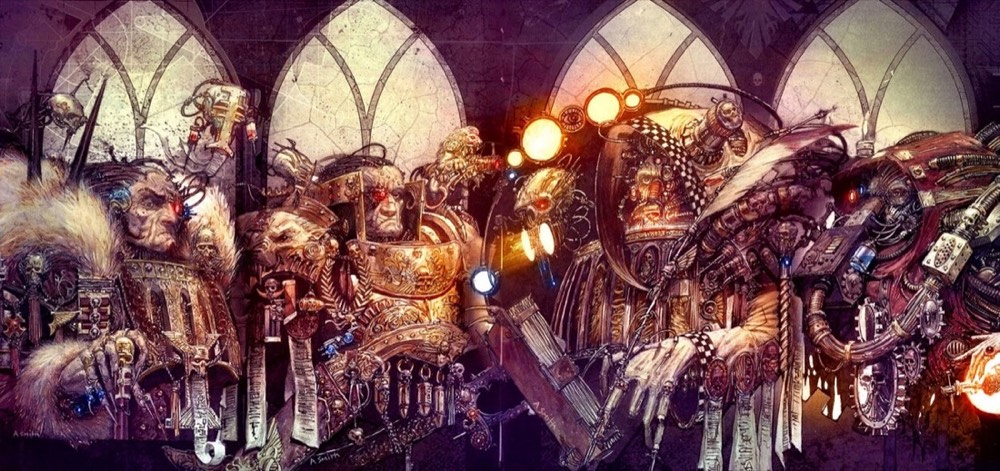
[edit]The day-to-day administration of the Senatorum is overseen by the Chancellor of the Imperial Council, a bureaucratic official who is not one of the Twelve but is powerful because of his closeness to power. There are also lesser lords, not counted among the Twelve, who have served the council at various times.[1]
Composition
[edit]Permanent and rotating seats
[edit]Nine offices are almost always represented, because they are the cornerstones of the Imperium: the Master of the Administratum, the representative of the Inquisition, the Ecclesiarch of the Adeptus Ministorum, the Fabricator-General of the Adeptus Mechanicus, the Grand Provost Marshal of the Adeptus Arbites, the Paternoval Envoy of the Navis Nobilite, the Master of the Astronomican, the Grand Master of the Officio Assassinorum and the Master of the Adeptus Astra Telepathica. The Inquisition's seat belongs to whichever individual it sends to a session, and the Paternova of the Navigators never leaves the Palace of Navigators, so a sent envoy speaks for the ruling house. The three remaining seats are filled from a pool that includes the Lord Commander of the Segmentum Solar, the Lord Commander Militant of the Astra Militarum, the Lord High Admiral of the Navis Imperialis, the Captain-General of the Adeptus Custodes, the Abbess Sanctorum of the Adepta Sororitas, the Chancellor of the Estate Imperium and the Speaker for the Chartist Captains.[1][2]
The absence of the Astartes
[edit]Almost no Space Marine has held a seat by right, though the council was founded by a primarch. This seems to have been Guilliman's intent. He held, as did the Emperor and as does the Codex Astartes, that the Space Marines exist to protect Mankind and not to rule it. The tradition broke only during the War of the Beast in the 32nd millennium, when the Imperial Fists Chapter Masters Koorland and Maximus Thane in turn chaired the council as Lord Commander of the Imperium.[1][3]
History
[edit]Magisters and Lords Civilian
[edit]The earliest forerunners were bureaucrats who followed the armies of the Emperor in the Unification Wars of the late 30th millennium to build the foundations of his government on a reunited Terra. These officials were called the Magisters Temporal. As the realm grew they were reorganised as the Lords Civilian, and the greatest four of these became the High Lords Civilian: the Chancellor of the Estate Imperium, the Grand Provost Marshal, the Master of the Administratum and the Lord Commander Militant of the Imperial armies. When the First Legion was introduced in the final years of the Unification, the posts were held by Pelops Dravagor, Uwoma Kandawire, Noum Retraiva and Kli-San Weia.[1]
Council of Terra (c. 798.M30–014.M31)
[edit]In the early Great Crusade the Emperor ruled directly and was advised by a War Council that included the Fabricator-General of Mars, the Paternova of the Navigator Houses and Malcador the Sigillite. When he left Terra to lead the Crusade, Malcador stayed as regent. After the Ullanor Crusade the Emperor gave the war to the primarchs under the new Warmaster Horus and returned to Terra to build the Imperial Webway. He also decided that the Imperium could no longer be ruled by himself and a council of primarchs alone, and created the Council of Terra for ordinary mortals, who had a right to a say in the management of the realm. The primarchs kept the War Council, whose power now ran only to the military direction of the Crusade. The primarchs disliked giving up their say to people they thought less capable, and this became one of the resentments that Chaos used to turn the Traitor Legions.[1][5]
During the Heresy the Council of Terra included Malcador as Regent of Terra and First Lord, Constantin Valdor, Captain-General of the Custodians, the Fabricator-General Zagreus Kane after the Schism of Mars began in 006.M31, the Master of the Administratum Simion Pentasian, the Grand Provost Marshal Harr Rantal, the Master of the Astra Telepathica Nemo Zhi-Meng, the Master of the Astronomican Cohran Hursula and the Chancellor Ossian, among others.[1][6]
Grand Council of Reconstruction (014.M31)
[edit]After the Siege of Terra the Emperor lay on the Golden Throne and Malcador was dead. The surviving Loyalist primarchs, among them Guilliman, Rogal Dorn, Leman Russ, Lion El'Jonson, Vulkan and the barely conscious Jaghatai Khan, met with Valdor and the new Fabricator-General Kane as the Grand Council of Reconstruction, a temporary government that also directed the early Great Scouring. The mortal members, afraid of another Heresy, gained much power as a counterweight to the primarchs, who had dominated Imperial politics until then. The Council was the forerunner of the Senatorum.[1][3]
Foundation of the Senatorum
[edit]Early in the Time of Rebirth the Senatorum formally replaced the Council of Terra as the Imperium's executive. Guilliman, who had taken the title of Lord Commander of the Imperium from Dorn, designed the new body, fixed its number at twelve, and sat as its chair and as Imperial Regent, commanding the whole of the armed forces. The older title of Warmaster had fallen out of favour. No date is recorded for the change of name, and the first full roll that Imperial records give is the one of 544.M32. In the early 32nd millennium the rise of the Imperial Creed and the Cult of the Saviour Emperor to the rank of state religion earned the Ecclesiarch a seat, which became permanent.[1][3][a]
War of the Beast and the Beheading
[edit]The roll of 544.M32 was the first complete roll known. Udin Macht Udo held the chair, the Lord High Admiral Lansung was the most powerful member, and the Grand Master of Assassins Drakan Vangorich had lost his seat to the Inquisition but still attended every meeting. In the war Koorland deposed Udo and was killed at the second assault on Ullanor. Thane succeeded him. In 546.M32 the High Lords were murdered in a single day on the order of Vangorich, whom Thane had named Lord Protector. He governed through puppet High Lords for nearly a standard century, until, after nearly eighty years of rule, Thane returned to Terra with the Imperial Fists and killed him in the Eversor Temple.[4][7]
Age of Apostasy
[edit]In the 36th millennium the High Lord Goge Vandire held both the Administratum and the office of Ecclesiarch. While the Reign of Blood ran its course the High Lords were powerless to act. When the Fabricator-General Gastaph Hediatrix demanded that they account for themselves and execute Vandire, he dissolved the Senatorum and declared the Space Marines and the Adeptus Mechanicus traitors. Vandire was killed by his own bodyguard, the Brides of the Emperor, who later became the Adepta Sororitas, after Sebastian Thor invaded Terra. The council was restored in about 378.M36, with checks that included the creation of the Ordo Hereticus, so that no man should again replace the Emperor as ruler.[8][1]
Era Indomitus
[edit]In 999.M41 Guilliman returned to Terra during the Terran Crusade, met the Emperor, and declared himself Lord Commander and Imperial Regent for the second time. He first dissolved the sitting Senatorum and ruled in person, and later restored the High Twelve with himself as chair, after he had replaced five of the Twelve and hundreds of lesser lords and founded the Officio Logisticarum and the Logos Historica Verita. The purge of the bureaucracy is called the Primarch's Scourge. Many High Lords opposed him, longing for the order that the Terran nobility had known as the Imperium Eterna, and some of the serving and deposed ones formed the Hexarchy under the former Master of the Administratum Irthu Haemotalion. The coup failed when the Grand Master of Assassins Fadix foiled it. The Senatorum is now the council through which Guilliman directs the Indomitus Crusade, and for the first time in many millennia a single man controls the day-to-day work of the Imperium.[9][3][1]
Timeline
[edit]| Date | Event |
|---|---|
| Unification Wars | Magisters Temporal and Lords Civilian serve the Emperor in the Unification Wars. |
| c. 798.M30–014.M31 | The Council of Terra sits in the Palace under the regent Malcador. |
| 006.M31 | Zagreus Kane joins the Council after the Schism of Mars. |
| 014.M31 | The Grand Council of Reconstruction takes charge after the Siege of Terra. |
| Early Time of Rebirth | The Senatorum is formed under Guilliman's regency. |
| Early M32 | The Ecclesiarch is given a seat. |
| 544.M32 | First full roll of the twelve, at the opening of the War of the Beast. |
| 546.M32 | The Beheading. |
| 546–646.M32 | Vangorich governs for nearly a standard century and is killed by Thane after nearly eighty years of rule; the council is rebuilt.[b] |
| c. 378.M36 | Dissolved by Vandire; restored after his death. |
| 999.M41 | Guilliman returns, dissolves the council and later restores it. |
| M42 | The Hexarchy coup is foiled by Fadix. |
See also
[edit]
Notes
[edit]References
[edit]- ^ a b c d e f g h i j k l m n o "High Lords of Terra". Warhammer 40k Wiki (Fandom). Sources include Codex: Imperialis (2nd edition), pp. 13-14, and Dark Heresy: Blood of Martyrs (roleplaying game), pp. 9, 12, 14, 17, 22.
- ^ a b c Leviathan Rulebook (10th edition). Games Workshop. p. 226. Psychic Awakening: War of the Spider (9th edition). Games Workshop. pp. 32, 51.
- ^ a b c d e f Wraight, Chris. Ashes of the Imperium (novel). Black Library. chs. 18, 37. Haley, Guy. Dark Imperium (2nd edition, novel). Black Library. chs. 12, 20.
- ^ a b Guymer, David. Echoes of the Long War (novel). Black Library. ch. 6. Dembski-Bowden, Aaron. Master of Mankind (novel). Black Library. ch. 3.
- ^ Goulding, L.J. The Last Council (short story). Black Library.
- ^ Wraight, Chris. Valdor: Birth of the Imperium (novel). Black Library. ch. 7.
- ^ Haley, Guy. The Beheading (novel). Black Library. ch. 13.
- ^ Wraight, Chris. Watchers of the Throne: The Emperor's Legion (novel). Black Library. "Tieron", chs. 25-26.
- ^ Wraight, Chris. Watchers of the Throne: The Regent's Shadow (novel). Black Library. chs. 4, 28. Sanders, Rob. Legion of the Damned (novel). Black Library. p. 11.