
Edict of Nikaea
| Edict of Nikaea | |
|---|---|
| Decree of the Council of Nikaea | |
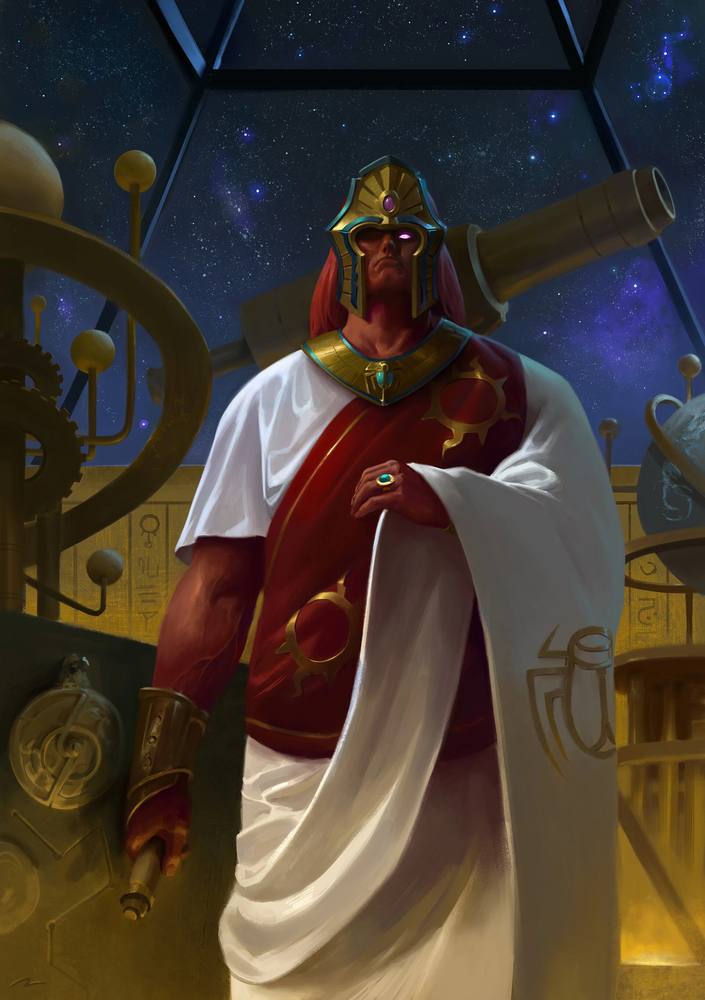 Magnus the Red, who argued at the council for research into psychic power rather than its ban Artwork © Games Workshop | |
| Decree | |
| Issued | 001.M31, on the world of Nikaea |
| Issued by | The Emperor of Mankind, at the Council of Nikaea |
| Applies to | The Legiones Astartes and their Librarius |
| Companion decree | The Chaplain Edict, which created the rank of Chaplain in every Legion |
| Status | Foundational; still cited in Imperial law on psykers |
The Edict of Nikaea is the decree issued by the Emperor of Mankind at the Council of Nikaea in 001.M31, during the Great Crusade. It ended the use of psychic combat within the Space Marine Legions and closed the Librarius of each Legion. It is one of the most consequential decrees of the Great Crusade, and its effects are still felt in the Adeptus Astartes and in Imperial law on psykers.[1]
The decree was made after a divisive debate. Some primarchs had argued that Librarians should be expanded, while others opposed the presence of psykers in their ranks altogether. The Emperor's ruling sided with the opponents of psychic combat, and it forbade the Legions to use psykers in battle.[2]
Content
[edit]The decree had three main parts. It banned the unrestricted use of psychic abilities, which the council defined as "sorcery", meaning the bargaining for power or knowledge with the entities of the Warp. It required the Legions to close their Librarius departments. And it ordered that the existing Librarians were to return to the duties of ordinary battle-brothers, and never use their abilities again.[2]
The decree was issued together with the Chaplain Edict, which required each Legion to create a specialist rank called Chaplain, based on the practice of the Word Bearers. A Chaplain was charged with keeping the Legion faithful to the Imperial Truth and with maintaining the morale and dedication of its warriors.[2]
Debate at Nikaea
[edit]The debate at Nikaea is recorded as one of the most divided in the council. The Emperor was the most powerful human psyker of all, but he had come to regard the Warp as a source of corruption. The Witch Hunters argued against psychic power, while Magnus the Red argued that the Emperor should not ban psychic abilities, but should fund research into them so that they could be used for the benefit of Humanity. Magnus's arguments were powerful, and the council was split until the Emperor decided the question.[2]
The decision was unpopular among several primarchs. Some of them regarded the council as a body of lesser men placed over them, and the loss of their voice in the government of the Imperium was among the grievances that later agents of the Chaos gods exploited.[1]
Consequences
[edit]The Thousand Sons Legion, whose primarch had argued for psychic research at the council, is recorded as having defied the Edict. The Edict also shaped the later Imperial rule against unsanctioned psykers, which is set out in the Lex Imperialis.[2]
The Edict was not a complete ban on all psychic power. The Imperium later relied on psykers in the Astronomican and in the Adeptus Astra Telepathica. The Edict applied to the Legions, and the Imperial record treats the psykers of the Imperium as a separate matter.[2]
See also
[edit]

Notes
[edit]- The debate and the Chaplain Edict are recorded in the Imperial accounts of the council. The exact wording of the Edict is not preserved in the sources consulted.
References
[edit]- ^ a b Goto, C.S.. Blood Ravens: The Dawn of War Omnibus (novel). Black Library, "The Trials of Isador," pp. 270-272. Kyme, Nick. Salamander (novel). Black Library, Part I, pg. 91.
- ^ a b c d e f McNeill, Graham. A Thousand Sons (novel). Black Library. Abnett, Dan. Prospero Burns (novel). Black Library.