
Codex Imperialis
| Codex Imperialis | |
|---|---|
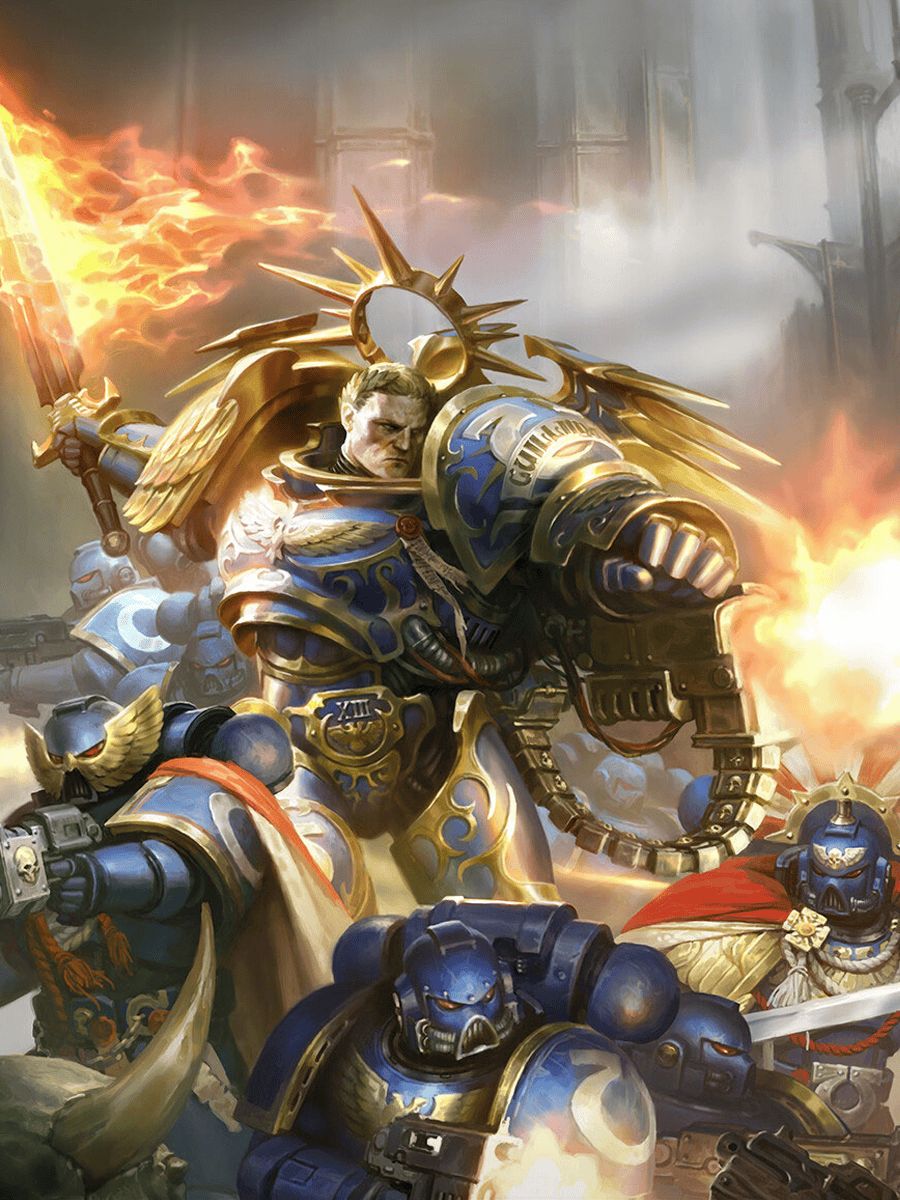 Roboute Guilliman, Lord Commander of the Imperium, author of the work, with his Ultramarines Artwork © Games Workshop | |
| Author | Roboute Guilliman, primarch of the Ultramarines |
| Offices held | Lord Commander of the Imperium, Imperial Regent |
| Begun | Early Era Indomitus, after 999.M41 |
| Subject | The civil and social institutions of the Imperium of Man, and a history of the Imperium from the Great Crusade |
| Predecessor | The Codex Astartes |
| Status | Unfinished; in the course of being written[a] |
The Codex Imperialis is a treatise on the civil government of the Imperium of Man, begun in the early years of the Era Indomitus by the primarch Roboute Guilliman of the Ultramarines, in his capacity as Lord Commander of the Imperium and Imperial Regent.[1] It is conceived as the companion of the author's earlier work, the Codex Astartes, written in the wake of the Horus Heresy ten thousand years before.
The two works differ in subject. The Codex Astartes was a guide to the strategy and tactics of the Adeptus Astartes. The Codex Imperialis deals chiefly with civilian matters: it is a guide to reorganising the political and social institutions of the Imperium, so that the realm may be brought closer to the ideals of betterment held by the Emperor of Mankind during the Great Crusade.[1] It is therefore not a body of military doctrine, and it should not be confused with the Tactica Imperium, which governs the regiments of the Astra Militarum, or with the Codex Astartes, which governs the Chapters.
The work is also a history. Guilliman means it to be the first accurate account of the Imperium from the Great Crusade to the opening of the Era Indomitus and the birth of the Great Rift, written without the propaganda and religious superstition that have gathered about the record. In this it returns to the intent of the Imperial Truth, long forgotten in the present Imperium.[1]
History
[edit]Background
[edit]Guilliman was struck down at Thessala in 121.M31 and lay in stasis for ten millennia. He was restored to the Imperium in 999.M41, as the Great Rift opened across the galaxy, and was named Lord Commander of the Imperium and Imperial Regent.[1] He found a realm that had drifted far from the aims of the Great Crusade, its government grown vast, sluggish and bound by tradition, and its history overlaid with the doctrines of the Imperial Cult.
Composition
[edit]Guilliman took up the work in the first years of the Era Indomitus, alongside the war effort of the Indomitus Crusade. He had written the Codex Astartes after the Heresy as a reply to the causes of that war, and he approached the present task in the same way, as an attempt to set down the principles by which the Imperium ought to be run before the realm could be changed.[1] Imperial scholars regard the text as a work in progress, and the Lord Commander is said to revise it as the war and his study of the Imperium's institutions proceed.[a]
Contents
[edit]The surviving accounts describe the work as having two parts, a programme of reform and a history.[1] What is known of its detailed provisions is slight, and the entries below record only what the sources state.
Reform of the Imperium
[edit]The first part concerns the political and socioeconomic institutions of the Imperium. Its purpose is to restore a realm of countless worlds to a condition closer to that which the Emperor envisaged in the Great Crusade, a condition of human betterment rather than of inertia and fear.[1] The offices concerned lie in the older civil bodies of the state, among them the High Lords of Terra, the Administratum and the Adeptus Terra, though the sources do not set out how the text treats each.[b]
History of the Imperium
[edit]The second part is a work of scholarship, and it is the one that most distinguishes the Codex Imperialis from its predecessor. Guilliman intends it to be the first truly accurate history of the Imperium, running from the Great Crusade down to the birth of the Great Rift. It is to be free of the propaganda that the state has used to shape the memory of the Heresy and the Emperor's rule, and of the superstition of the Imperial Cult, which holds the Emperor to be a god.[1] The undertaking is a delicate one, since the Imperial Truth itself was suppressed in the Great Crusade and its principles have been condemned as heresy in many places.
Relation to other doctrinal works
[edit]The Imperium's governing texts are divided by the body they serve, and no single book unites them. The table below sets out the three works most often confused.
| Work | Author | Subject | Applies to |
|---|---|---|---|
| Codex Astartes | Roboute Guilliman, c. 014–021.M31 | Organisation, doctrine and heraldry | The Adeptus Astartes |
| Tactica Imperium | Compiled by the Imperial military bureaucracy | Regimental organisation and tactics | The Astra Militarum |
| Codex Imperialis | Roboute Guilliman, from the early Era Indomitus | Civil reform and a true history | The state and its institutions |
Guilliman is the common author of the first and third. The Codex Astartes is a settled text which the Chapters have followed for ten thousand years, whereas the Codex Imperialis is still being composed. The Tactica Imperium is of different origin, a compendium built up over the centuries in the military bureaucracy rather than a single treatise from one author.
Earlier use of the title
[edit]The name appears in Imperial records long before the Era Indomitus. Chronological tables, planetary classifications and the registers of several institutions cite a Codex Imperialis as a reference compendium, in connection with the Adeptus Terra, the Administratum and the arrangement of the Imperium's worlds and offices.[2] The chronologies of the Forging refer to it, and a revision dated 980.M41 is cited in the record of the Nova Terra Interregnum.[2]
Imperial scholars do not agree on how this compendium relates to Guilliman's treatise. Some hold it to be an older reference work of the same name, kept by the Adeptus Terra, which the Lord Commander knew when he chose the title for his new text. Others hold that later copyists applied the name to the new treatise, and that the older citations are to a different work altogether. No account settles the question, and the sources that cite the older work do not describe its author.
Influence
[edit]The Codex Imperialis is unfinished, and its effect on the Imperium is therefore difficult to measure. Its existence is itself significant. The Lord Commander has set himself to reform the civil government of the Imperium as he reformed the Space Marines in the age after the Heresy, and the institutions of Terra are aware of it.[1] The old guardians of the Imperial faith have good reason to watch its history of the Imperium closely, since a record written without superstition may undermine claims on which the Imperial Cult rests.
Within the Ultramarines, and among the officers of the Lord Commander's court, it is regarded as the next stage of the work that began with the Codex Astartes. Whether it will, like that text, become the standard by which the Imperium is judged remains to be seen.
Timeline
[edit]| Date | Event |
|---|---|
| c. 014–021.M31 | Guilliman writes the Codex Astartes. |
| 121.M31 | Guilliman is placed in stasis after Thessala. |
| 980.M41 | Revision of an earlier Codex Imperialis cited in the record of the Nova Terra Interregnum. |
| 999.M41 | Guilliman is restored; the Great Rift opens; he is named Lord Commander and Regent. |
| Early M42 | Guilliman begins writing the Codex Imperialis during the Indomitus Crusade. |
See also
[edit]
Notes
[edit]- ^ a b Imperial accounts give no completion date, and nothing in the surviving record says how much of the work exists in final form.
- ^ The sources name no individual institution as the subject of a chapter. The offices listed here are those with the widest civil authority in the Imperium and are given for orientation only.
References
[edit]Further reading
[edit]- "Codex Imperialis". Warhammer 40k Wiki (Fandom).