
Chaos Knights
| Chaos Knights | |
|---|---|
| Questor Traitoris, the fallen houses of the Imperial Knight worlds | |
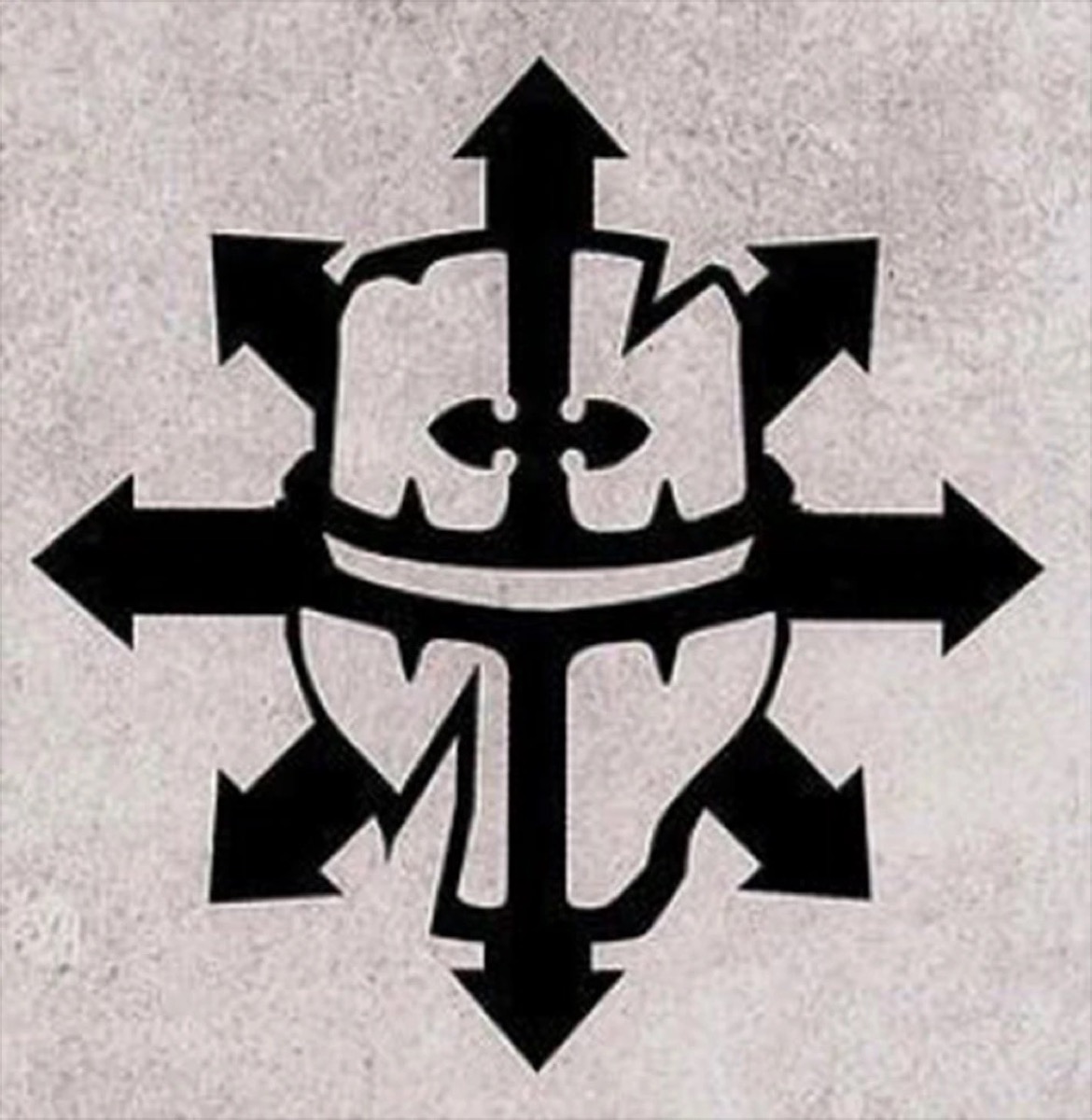
 The eight-pointed star of Chaos Artwork © Games Workshop | |
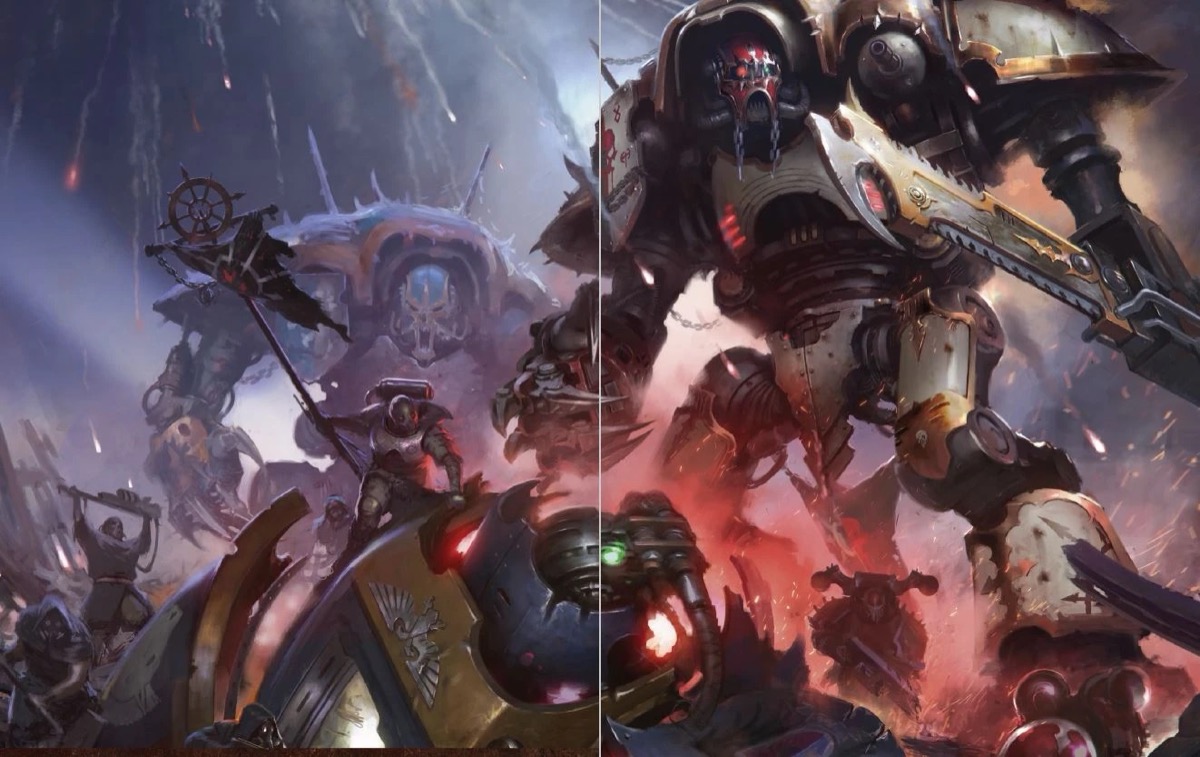
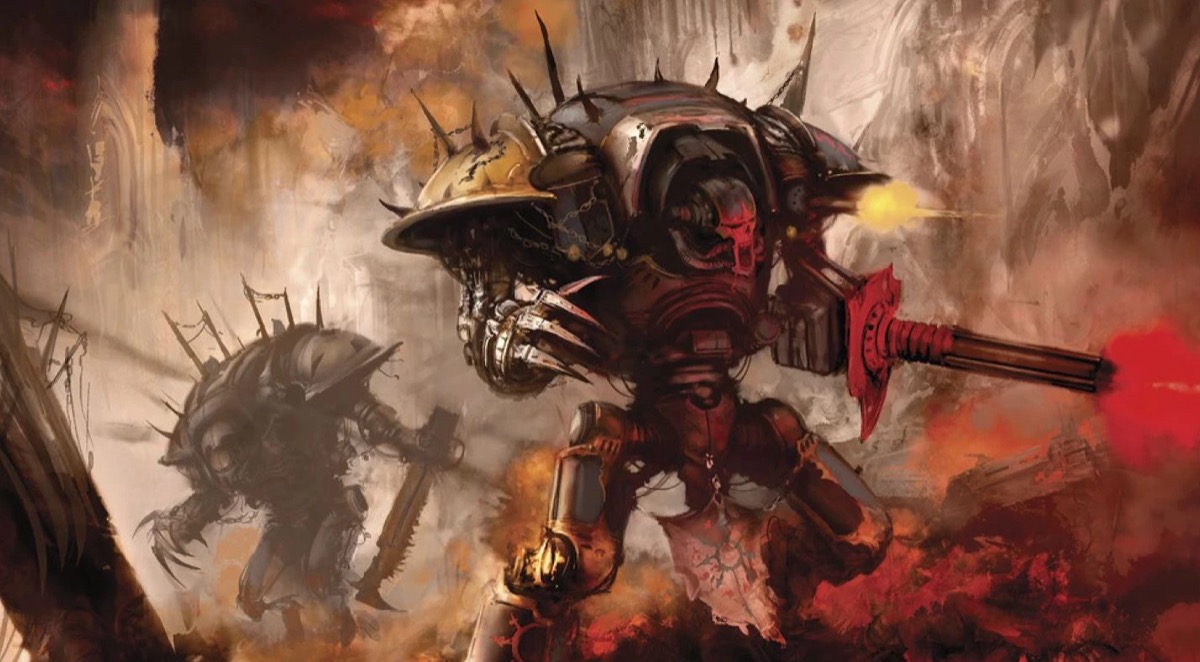 A Chaos Knight fires its heavy weapon while a second war machine advances behind it Artwork © Games Workshop | |
| Type | Bipedal war machines piloted by Fallen Nobles |
| Established | Horus Heresy, from 005.M31 |
| Allegiance | Chaos, the Dark Gods |
| Headquarters | Fallen Knight Worlds across the galaxy; traitor fleets in the Eye of Terror |
| Leaders | Lords of individual houses; Chaos Lords who hire lone Knights |
| Formations | |
| Infernal households | Iconoclast households |
| Dreadblades | Freeblades turned to Chaos |
| Notable actions | |
| Battle of Molech (009.M31); Siege of Terra (013–014.M31); Battle of Beta-Garmon (006–013.M31); the Great Rift campaigns (999.M41 onward) | |
The Chaos Knights, also called Renegade Knights, Daemon Knights and, in High Gothic, Questor Traitoris, are Imperial Knight war machines and their Fallen Noble pilots, corrupted to the service of Chaos. Each is a walker that carries the firepower of a small army, and Imperial officers have long recorded that one Chaos Knight can break an armoured column or a regiment on its own.[1]
The corruption works slowly. A Knight that falls to Chaos usually looks unchanged at first. Over years or centuries, Warp energy seeps into its Machine Spirit and alters its form, and its Throne Mechanicum fills with the minds of pilots who have turned to the Dark Gods. Imperial accounts describe the process as a rot that starts in the core and reaches the armour last.[1][2]
Chaos Knights fight in three main forms: lone Dreadblades serving whoever pays them, Infernal households that serve the Dark Mechanicum, and Iconoclast households that owe their loyalty to the gods or to a warlord. The Imperium treats all three as Traitoris, and the Ordo Hereticus hunts them as heretics. Imperial accounts stress that the Noble houses which turned were once among the most steadfast servants of the Emperor, which makes their fall harder for the Imperium to accept.[1]
History
[edit]Colonisation and the Age of Isolation
[edit]The first Knight suits were made in the early millennia of human expansion. Colonists sailed from Terra aboard Long March generation ships, and some groups carried Standard Template Construct databases that could make Knight suits. The pilots were also the leaders of their settlements, and their bloodlines became the first noble houses. Their Thrones Mechanicum shaped them into strict and conservative rulers, and this habit of obedience later became the Code Chivalric.[1][a]
The Age of Strife (c. M25–M30) cut most colony worlds off from one another. Many fell into war, and psykers and mutants were persecuted or drove their worlds into anarchy. The Knight worlds held out. Their houses purged mutation from their bloodlines, rejected thinking machines and used their Knights to defend their people. Their rulers' pride grew with their isolation, and this was later one of the causes of the Heresy.[1]
Great Crusade
[edit]The Great Crusade (798.M30 to 005.M31) found many Knight worlds in this state. A Rogue Trader named Jeffers was among the first to report one to the Administratum. Most noble houses swore fealty to the Crusade, and the Adeptus Mechanicus of Mars secured the strongest oaths, since it wanted the archeotech of the Knight worlds. Other houses swore directly to the Emperor of Mankind, and in return their Sacristan orders were taught Mechanicum techniques.[1]
Horus Heresy
[edit]When the Horus Heresy began in 005.M31, many Imperial commanders believed the Noble houses could not be corrupted, since their Thrones were thought to make them loyal. The Heresy proved otherwise. Knight houses sworn to Mars followed the Dark Mechanicum when it turned to Horus, and Knight houses bound to Traitor Legions followed their lords into rebellion. Some houses turned on their own kin, and some Nobles were bound to the Dark Gods by rituals.[1][2]
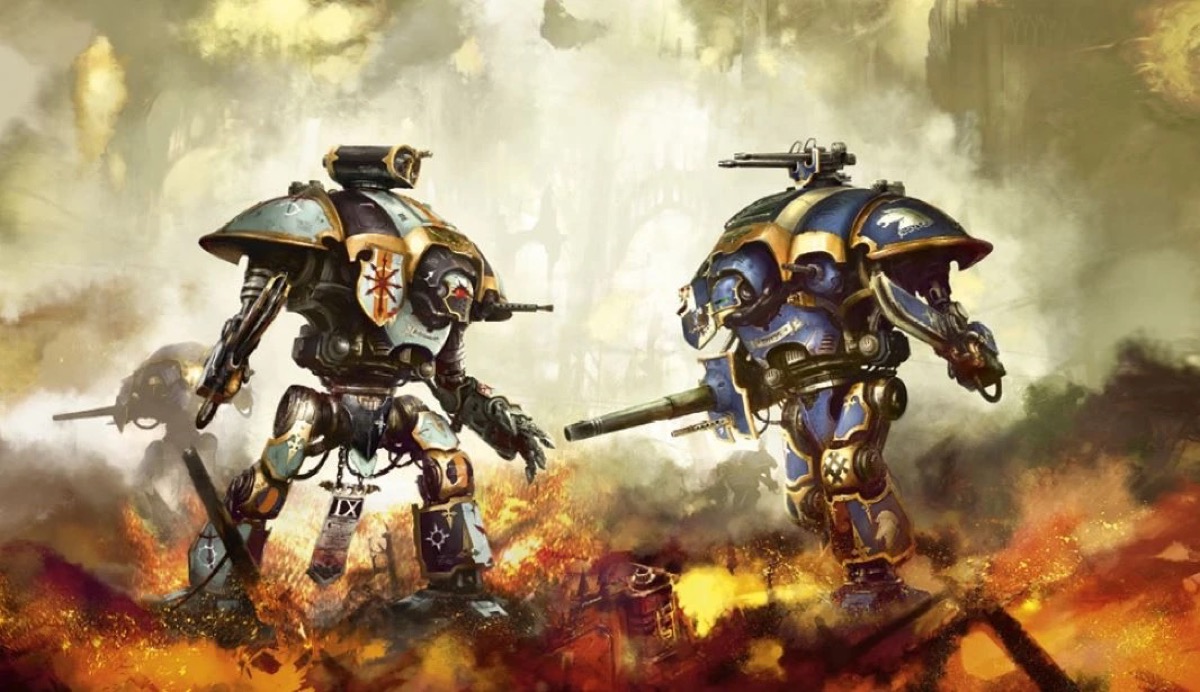
The Knights fought on both sides at the Battle of Beta-Garmon (006–013.M31), and their duels there were among the bloodiest of the war. At Molech in 009.M31, House Devine turned on the Loyalist defenders during the Warmaster's attack. Its defection decided the battle and gave the Traitors the approach to Terra, and it is usually counted as the first house of Chaos Knights.[1][2] At the Siege of Terra in 013–014.M31, Imperial accounts record Chaos Knights in the Traitor armies. One record names the Chaos Knights of House Vyronii, but the Imperial sources disagree about the number of Knights at Terra and the names of their houses.[b][2]
Age of Degradation
[edit]After the Heresy, many Imperial officers believed the threat of the Chaos Knights had passed. It had not. Over the next centuries, Knight houses fell one by one, and in some years several worlds were lost in a single decade. The fallen houses became raiders, and their lords hired out lone Knights as mercenaries. The Imperium records their campaigns across the galaxy, from the Kreen Worlds to the Dysephamine System, but few of these accounts have exact dates.[1][c]
Imperial scholars call the centuries of fighting after the Heresy the Long War. The Knight households of this period were drawn into the war against Chaos and the xenos, and many were lost to the Imperium on the same worlds where their Loyalist kin were still defending the Throne.[1]
Era Indomitus
[edit]The opening of the Great Rift in 999.M41 cut many Knight worlds off from Terra and Mars, and some fell to Chaos. When Abaddon the Despoiler launched the 13th Black Crusade in the same year, Iconoclast and Infernal households and Dreadblades from across the galaxy joined his banner. Dread lances struck worlds where Imperial reinforcements were on their way, to hold the approaching armies in place.[1][3]
Knight worlds on the Rift's edges have also been transformed directly. Some planets were enveloped by Warp storms, and when they emerged their populations had been devoured by daemons and their war machines were remade. The Nachmund Gauntlet passage through the Rift led to the rediscovery of Dharrovar, a Knight world lost since the Heresy. Renegade houses have also appeared along the Rift, including the household of Mandrakor on Dharrovar.[3]
Households and Dreadblades
[edit]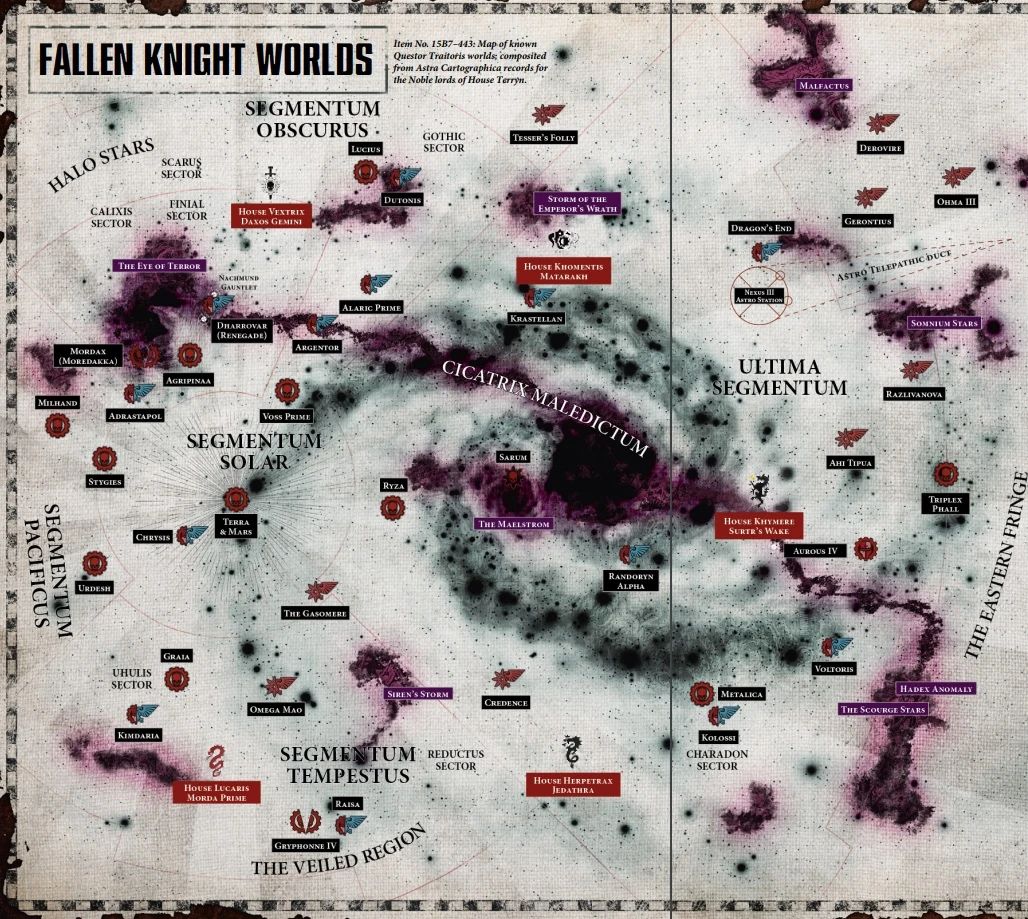
Infernal households
[edit]Infernal households are whole Knight houses that have joined the Dark Mechanicum or a Traitor Titan Legion. Their Knights are fitted with techno-sorcery, and the Throne Mechanicum of each is said to hold summoned daemonic entities as well as the spirits of earlier pilots. The Imperium recognises them by their dark-red and bronze heraldry and by the rune marks on their armour.[1]
Iconoclast households
[edit]Iconoclast households have more varied allegiances. Some still swear oaths to a Heretic Astartes Legion or to a Chaos God, and others have broken with the Imperium entirely to build their own dread realms. Their heraldry is usually stripped of Imperial symbols and replaced with the marks of their new lords.[1]
Dreadblades
[edit]A Dreadblade is a single Chaos Knight that has turned against its own household, often by killing its kin, and that now serves as a mercenary. Dreadblades work as lone wolves and sell their strength to warlords in return for relics, arcane knowledge or fief worlds. Their most notable members include Litany of Destruction, which fought beside the Iron Warriors at Tellerax Prime, and the Gilded King, which took up a quest for lost archeotech. Dreadblades are often followed by warbands of Chaos Space Marines and by cultists who worship the machines.[1]
Design and pilots
[edit]The Throne Mechanicum
[edit]A Chaos Knight is piloted from a Throne Mechanicum in the larger classes, or a Helm Mechanicum in the smaller ones. Neural jacks connect the pilot's nervous system to the machine, and the pilot can drive the Knight's limbs and weapons by will alone. The Throne holds the echoes of earlier pilots, whose suffering grows as the Knight is warped. Only the most resilient Fallen Nobles can bear this for long, and the others are burned out or consumed.[1]
The Ritual of Becoming
[edit]Young nobles are bonded to a Throne in the Ritual of Becoming. Among the Chaos Knights this ritual is tainted by Warp entities and by the sorceries of their lords, so that a new pilot may come out of it changed. Imperial records describe Fallen Nobles as "wired into" their war machines in a way that gives the pilot's will a hold over the Knight's weapons.[1]
Heraldry
[edit]Chaos Knights are marked with the eight-pointed star of Chaos and with the marks of the Dark Gods that they serve. The symbol of the Questor Traitoris is a black Chaos star with a skull-helm at its centre, and it is painted or cast onto the armour of most Chaos Knights.[1]
Notable houses
[edit]| House | Origin | Notes |
|---|---|---|
| House Devine | Molech | First house to fall, at the Battle of Molech in 009.M31 |
| House Vyronii | Unknown | Named in a disputed record of the Siege of Terra |
| House Mandrakor | Dharrovar | Renegade household found on the Nachmund Gauntlet |
| House Herpetrax | Unknown | Campaigned through the Kreen Worlds, a manufactorum hub |
| House Qiln | Cobbran | Infernal house, overrun by Orks in an Ork invasion of its world |
Timeline
[edit]| Date | Event |
|---|---|
| c. M15 | Long March colonies carry Knight suits to new worlds |
| c. M25–M30 | The Age of Strife; the Knight worlds hold out in isolation |
| 798.M30 to 005.M31 | The Great Crusade reunites the Knight worlds |
| 005.M31 | The Horus Heresy begins; the first Knight houses fall |
| 006–013.M31 | Knights fight on both sides at the Battle of Beta-Garmon |
| 009.M31 | House Devine betrays Molech |
| 013–014.M31 | Chaos Knights fight in the Solar War and at the Siege of Terra |
| c. M31–M41 | The Age of Degradation; Knight houses fall one by one |
| c. M36 | Dreadblades and renegade houses hire out as mercenaries |
| 999.M41 | The Great Rift opens; Abaddon launches the 13th Black Crusade |
| 999.M41 onward | Knight worlds are swallowed or transformed along the Rift |
| Unrecorded, M42 | Dharrovar is rediscovered through the Nachmund Gauntlet |
| 000.M42 onward | Chaos Knights fight the fleets of the Indomitus Crusade |
See also
[edit]
Notes
[edit]- ^ The Long March colonies are dated c. M15 from the sequence of expansion in the early Imperial records. No single document gives the first year.
- ^ Records of the Siege of Terra are disputed. The Vyronii entry comes from a single Imperial summary and is not confirmed by the Solar War records.
- ^ Dates for the Age of Degradation are estimated from the order of the Imperial reports.
References
[edit]- ^ a b c d e f g h i j k l m n o p q Codex: Chaos Knights (9th Edition), pp. 3-37, 70-73, 75-78, 93, 96-109. Games Workshop. Clark, Andy. Kingsblade (novel). Black Library, Ch. 9.
- ^ a b c d Dembski-Bowden, Aaron. The Master of Mankind (novel). Black Library, Chs. 3, 8, 12, 15, 17, 20, 22, 24. Codex: Chaos Knights (8th Edition), pp. 3-39, 52-58, 62, 68-69. Games Workshop.
- ^ a b Codex Heretic Astartes - Death Guard (8th Edition), pg. 22. Games Workshop. Codex: Imperial Knights (8th Edition), pg. 55. Games Workshop.