
Isha
| Isha | |
|---|---|
| Goddess of the Aeldari pantheon | |
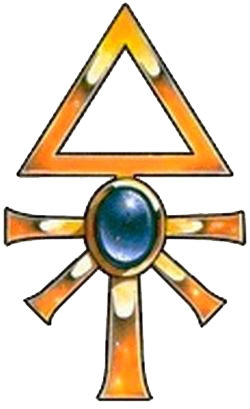 Rune of the Aeldari Artwork © Games Workshop | |
| Domain | Harvest, fertility, nature, life, healing and growth |
| Titles | Mother of the Aeldari; the Caged Maiden |
| Consort | Kurnous, god of the hunt |
| Kin in myth | Vaul, the smith-god (her uncle) |
| Enemies | Kaela Mensha Khaine; Slaanesh; Nurgle |
| Gifts | Love; the first spirit stones, made from her tears |
| Status | Captive in the garden of Nurgle since the Fall of the Aeldari (late M30)[a] |
Isha is the goddess of the harvest, fertility, nature, life, healing and growth in the mythology of the Aeldari, and the divine mother of their species. She is the consort of Kurnous, god of the hunt, and is held to be the only wholly benevolent member of the Aeldari pantheon. Aeldari myth credits her with the creation of the first spirit stones, made from the tears she wept when she was parted from her children.[1][2]
When Slaanesh was born in the Fall of the Aeldari and devoured the Aeldari gods, Isha was not consumed but taken captive; Nurgle then made war on Slaanesh and carried her off to his garden in the Realm of Chaos. The Aeldari believe that he keeps her there in a cage and tests every new plague on her, and that she whispers the cures into the universe for mortals to find. In the Era Indomitus some Aeldari have begun to hope that she might be freed.[3][4]
Myth
[edit]Aeldari tradition says that when the Aeldari first rose from the earth, nourished by Isha's tears, each god gave them a gift: Asuryan gave wisdom, Isha gave love, that they would know one another, and Kurnous gave desire. When Asuryan lost interest in his creations, it was Isha, some myths say, who made all the other living things of the universe so that the Aeldari would not be alone.[1][5]
The barrier and the spirit stones
[edit]The goddess Lileath dreamt that Kaela Mensha Khaine, god of war, would one day be brought down by mortals, and Khaine turned his fury on the Aeldari. Isha's weeping for her children moved Asuryan to raise a barrier between gods and mortals, the division between the Warp and realspace that stands to this day. Isha grieved again at the separation, and with Kurnous she went to Vaul, the smith-god, who made from her tears the first spirit stones. One she kept; the rest were given to the Aeldari so that their prayers could still be heard.[1][2]
Khaine's prisoners
[edit]Khaine learned that Isha was speaking with mortals and told Asuryan, who, angered that his command had been broken, gave Isha and Kurnous to Khaine. The war god tortured them in a burning pit until Vaul bargained for their release, promising to forge a hundred enchanted swords within a year. Vaul finished all but one, and to keep the bargain he passed off a mortal-made blade as the last. Isha and Kurnous were freed, but Khaine discovered the deception. The feud that followed, which the Aeldari call the War in Heaven, divided the gods. Vaul finished the last sword, Anaris, and fought Khaine with it, but was maimed and chained to his own anvil; the mortal hero Eldanesh took up Anaris in turn and was killed, and the blood of Eldanesh that stained Khaine's hands gave the god his name, the Bloody-Handed. Asuryan, who had taken no side and had come to regret his judgement on Isha and Kurnous, then declared the war at an end.[2][5][b]
Captivity
[edit]The Fall
[edit]When Slaanesh was born in the Fall of the Aeldari, it destroyed the Aeldari gods in the Warp and devoured them, except for the trickster Cegorach, who fled into the Webway, and Isha. Slaanesh defeated Isha but took her prisoner rather than consuming her. For what purpose, the Aeldari do not know, and Slaanesh did not keep its prize. Nurgle made war on the youngest of the Chaos gods to take her; some Aeldari scholars believe he meant to teach the newcomer its place. His daemons won, and he carried her back to his realm.[3][2][a]
The Caged Maiden
[edit]Nurgle, the Aeldari say, came to love Isha as he loves no other being, and he shows it in the only way he knows. He keeps her in a rusted cage in his manse in the corner of his garden, beside the cauldron in which he brews his plagues, and he tests every new disease on her. As goddess of healing she can cure herself, and Nurgle judges the strength of each plague by how hard she must struggle to do so; if he is pleased, he releases it on some mortal world. Isha bears this stoically and resists as she once resisted Khaine, whispering the cure to each new disease into the universe so that mortals may find it. Aeldari legend holds that rose-like flowers grow where she walks, and that they guard any mortal who carries them against the corruption of Chaos.[3][6]
Belief in the Caged Maiden is not confined to the Aeldari. Sanistasia Minst, a leading rejuvenat adept of the Talassar Sector, began after one successful cure to dream of a maiden in a cage forced to suffer every disease in turn, and became obsessed with making a panacea that could heal even a god. She later joined the crew of the Rogue Trader Elucia Vhane.[7][c]
History
[edit]The Seers of Lugganath
[edit]In 975.M41 the craftworld Lugganath was struck by a disease called the Brittle Coma. Believing the tale of the Caged Maiden to be literal truth, an army of its most gifted Seers cast their minds into Nurgle's garden to find Isha, free her and so lift the plague. Expecting to die, they trusted that their souls would return to the spirit stones of their comatose bodies and bring Isha's word home. At first they passed through the garden with ease, but the flies of that realm warned Nurgle, and hosts of Plaguebearers rose from the mud to bar their way. The Seers fought for days in the garden's reckoning and blasted great swathes of it with psychic fire. In the material world, however, their bodies succumbed to the very plague they hoped to cure, and their spirit stones rotted. Cut off from realspace, they were claimed by the garden and became trees, a weeping copse that now pleases Nurgle on his walks and grieves his captive.[3]
The Rose of Isha
[edit]When Mortarion of the Death Guard used the relic called the Hand of Darkness to spread plague across Ultramar in the Plague Wars, in about 999.M41, Roboute Guilliman and Varro Tigurius told the Farseer Eldrad Ulthran, who sent Yvraine and her Ynnari to steal it from the Whispering Tower on the Plague Planet. To reach the tower without exposing themselves to the Eye of Terror, Yvraine's party passed the trials of Slaanesh at the hidden craftworld of the Black Library and won a Rose of Isha. The rose let them enter Nurgle's garden and pass through it to the Plague Planet, where they took the Hand of Darkness.[8][9]
Era Indomitus
[edit]After the Great Rift opened, the Great Unclean One Rotigus began moving from one maiden world of the Eastern Fringe to the next, bringing a deluge of rot and corrupting fecundity. On each world, the Harlequins of the Masque of the Frozen Stars fought their way to the shrine of the world spirit and danced until every Aeldari who watched was weeping; the rain then turned clean, and Nurgle's corruption was undone. A rumour spread among the Exodite tribes that the Masque was seeking more than victory over Rotigus: that if enough Aeldari wept for their worlds, their sorrow might free Isha from her cage. No one can say whether this is possible, but with Cegorach surviving and Ynnead, god of the dead, slowly waking, some Aeldari dare to hope for a pantheon restored.[4]
Timeline
[edit]| Date | Event |
|---|---|
| Mythic age | The barrier between gods and mortals; the first spirit stones; the War in Heaven of the gods |
| Late M30 | The Fall; Isha taken by Slaanesh, then by Nurgle[a] |
| 975.M41 | The Seers of Lugganath lost in Nurgle's garden |
| c. 999.M41 | Yvraine uses a Rose of Isha to reach the Plague Planet |
| Early M42 | The Masque of the Frozen Stars opposes Rotigus on the maiden worlds[d] |
See also
[edit]Notes
[edit]- ^ a b c Imperial scholars place the Fall in the late 30th millennium.
- ^ Imperial scholars hold that the Aeldari War in Heaven preserves a memory of the War in Heaven between the Old Ones and the Necrontyr, more than sixty million years ago.
- ^ Minst's dates are not recorded; she served in the late 41st millennium.
- ^ Dated only to the period after the opening of the Great Rift.
References
[edit]- ^ a b c Codex: Eldar (4th edition). Games Workshop. pp. 5-6, 9.
- ^ a b c d Codex: Eldar (6th edition). Games Workshop. pp. 17-19, 21, 23.
- ^ a b c d Codex: Chaos Daemons (6th edition). Games Workshop. pp. 15, 23.
- ^ a b Codex: Harlequins (8th edition). Games Workshop. p. 30.
- ^ a b Warhammer 40,000: Compilation (1st edition). Games Workshop. pp. 35-36, 42.
- ^ Codex: Chaos Daemons (4th edition). Games Workshop. p. 82.
- ^ Codex: Elucidian Starstriders (8th edition). Games Workshop. pp. 14-16.
- ^ Thorpe, Gav. Rise of the Ynnari: Ghost Warrior (novel). Black Library. pp. 26-36.
- ^ Thorpe, Gav. Hand of Darkness (audio drama). Black Library.