
Tomb world
| Tomb world | |
|---|---|
| Planetary type of the Necrons | |
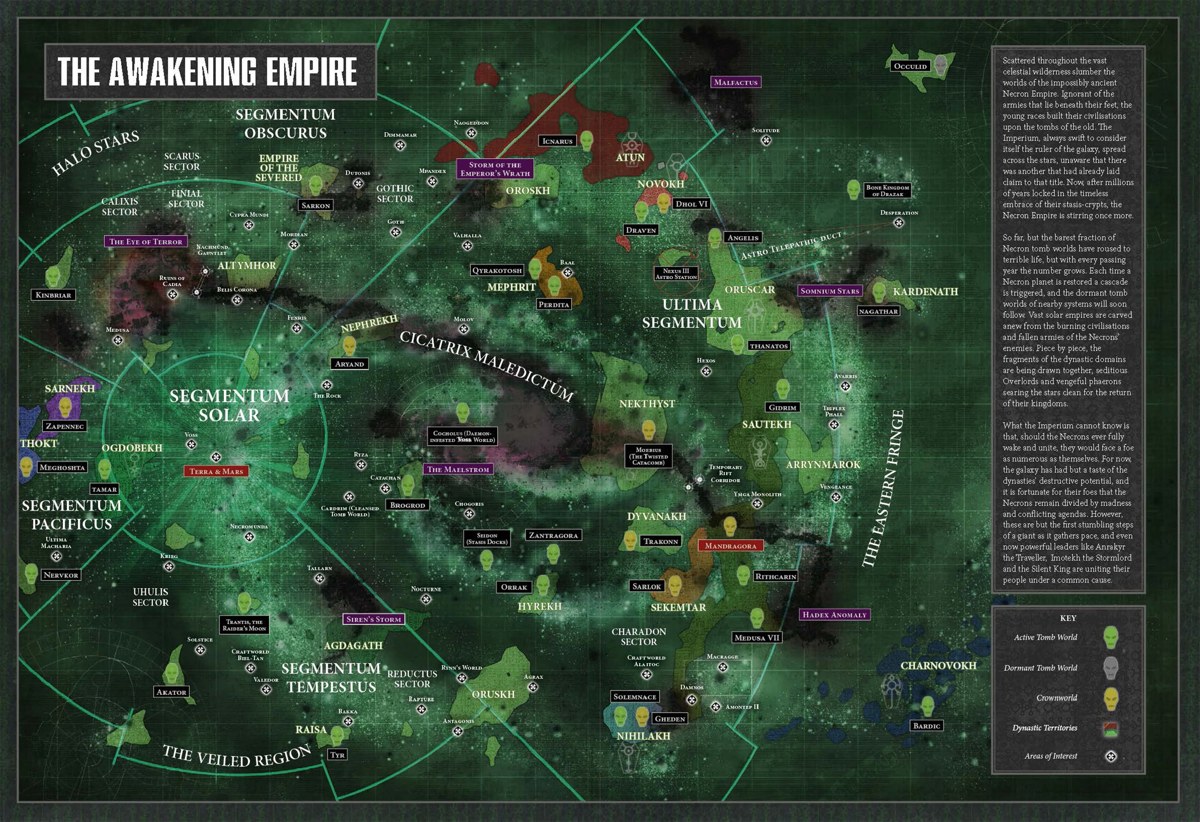 Ordo Xenos chart of known tomb worlds and dynastic territories after the opening of the Great Rift Artwork © Games Workshop | |
| Builders | The Necrontyr, after their biotransference into the Necrons |
| Sealed | More than 60,000,000 years before M41, at the end of the War in Heaven |
| Ranks | Crownworld, Coreworld, Fringeworld |
| Governed by | A Necron overlord or lord, under a phaeron of its dynasty |
| Number | Unknown; Imperial estimates speak of millions |
| Known examples | Mandragora, Solemnace, Drazak, Damnos, Gehenna, Morrigar, Sanctuary 101 |
| First Imperial record | 897.M41 (Sanctuary 101)[a] |
A tomb world is a planet on which the Necrons entered their long hibernation, the Great Sleep, more than sixty million years ago, sealed in vast stasis-crypts beneath the surface. Each holds an army, a nobility and an arsenal preserved against time, waiting for the moment when its automated systems judge that the galaxy is ready to be retaken. The Ordo Xenos believes the number of such worlds to be very large; the Necrons themselves rank them as Crownworlds, Coreworlds and Fringeworlds, according to their place in the dynasty that owns them.[1][2]
Many tomb worlds look like nothing more than barren dead worlds, and many have been settled by younger species who had no idea what lay below them. The awakening of such a world is usually violent: the tomb treats the settlers as intruders and destroys them. Since the late 41st millennium tomb worlds have been waking across the galaxy in growing numbers, and in the Era Indomitus the return of the Silent King has begun to draw them back into a single empire.[1][3][4]
Origin
[edit]The tomb worlds were built at the close of the War in Heaven. After the Necrontyr had been transferred into deathless machine bodies by the C'tan, and after they had turned on and shattered their star-gods, the last Silent King, Szarekh, ordered his people to sleep until the Aeldari, heirs of the Old Ones, had faded. Every tomb was built to a common template devised at the height of Necrontyr power. Using a mastery of dimensional geometry that no other species has since recovered, the builders made chambers that held tens of thousands of warriors in a space larger inside than out, and set temporal stabilisers that guarded the sleepers and their weapons against the passage of time in the manner of a stasis field.[1][3]
Some tomb worlds were the inhabited planets of the old Necrontyr, and the ruins of their cities still stand on or under the surface. Others are dead deserts. Adeptus Mechanicus savants are divided on whether these worlds were stripped of life by the Necrons in the distant past or whether such climates were simply the ones the Necrontyr preferred.[1]
Organisation
[edit]Ranks of world
[edit]Necron society is strictly hierarchical, and so are its worlds. Each dynasty is ruled from one Crownworld, the oldest and proudest of its planets, which once received the tithes and tribute of the whole realm. That wealth bought the best stasis-crypts, and the inhabitants of a Crownworld that has escaped outside disaster have usually come through the millennia in excellent condition. Below the Crownworld stand the Coreworlds, which together form the heart of the dynasty's territory and are ruled by close kin of the phaeron. Least are the Fringeworlds: poor or distant colonies whose contribution was labour or the keeping of prisons, and some former Coreworlds of other dynasties that were conquered and demoted.[2]
There is no typical tomb world. Each answers to its own noble ruler, whose tastes decide everything from its campaigns to its architecture and the forms of address used among its court. What all have in common is the purpose of restoring the dynasties and the Necrons' dominion over the galaxy.[2]
The tomb complex
[edit]The tomb complex itself is usually vast and cavernous. It holds the stasis-crypts of the sleeping legions, armouries, and repair halls tended by Canoptek constructs that restore warriors damaged in battle. At its centre the ruling overlord or lord, sometimes called a tomb lord, lies in a great sarcophagus of black stone.[3]
Awakening
[edit]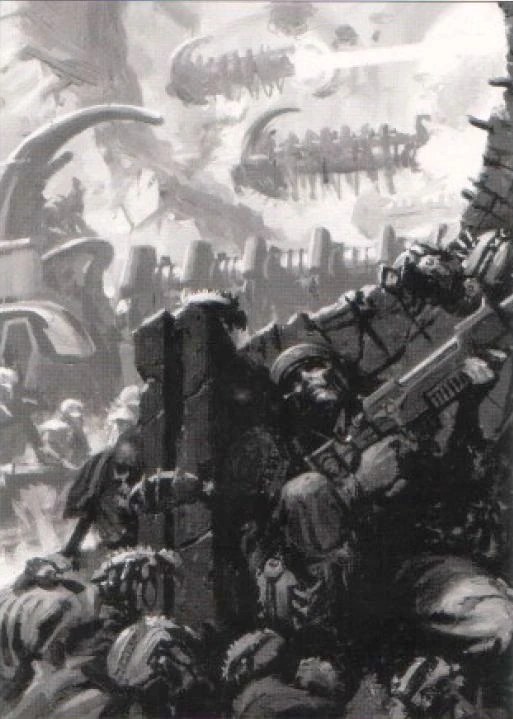
A tomb wakes in a fixed sequence, laid down by its builders. First come swarms of Canoptek scarabs and spyders, which open and repair the crypts and clear out intruders. Next a few Necron warriors are woken and sent to scout the surrounding region. The tomb's systems weigh what these scouts report and wake further forces and weapons as the situation demands. The lords are woken last, carrying encoded memories and the data needed to restore their personalities, so that they can take up the purpose of their world and act on their own judgement.[3][1]
Imperial records show that the worlds that wake fastest are those on which a large population of a younger species, usually human, has unknowingly settled. The tomb's programming treats such settlers as a threat to its charges and responds with great violence. Explorator teams of the Adeptus Mechanicus and Rogue Trader expeditions searching Necrontyr ruins for STC fragments or xenos artefacts have often been the trigger; many were never heard from again.[1]
Nodal Command
[edit]Earlier Mechanicus studies, written when the Necrons were thought to be soulless machines, described the command of a woken tomb as Nodal Command. In that analysis the lords formed nodes in a graded hierarchy, which the tech-priests named Bronze, Silver, Gold and Platinum, and a tomb answered every escalation by an enemy with a larger force of its own, withdrawing its first army and committing a stronger one under higher-ranked lords. Later study, after the Necron nobility was found to be fully self-aware and quarrelsome, treats the scheme as an incomplete picture: it describes the automated stages of an awakening well, but not the politics of the courts that follow.[3][1]
Distribution
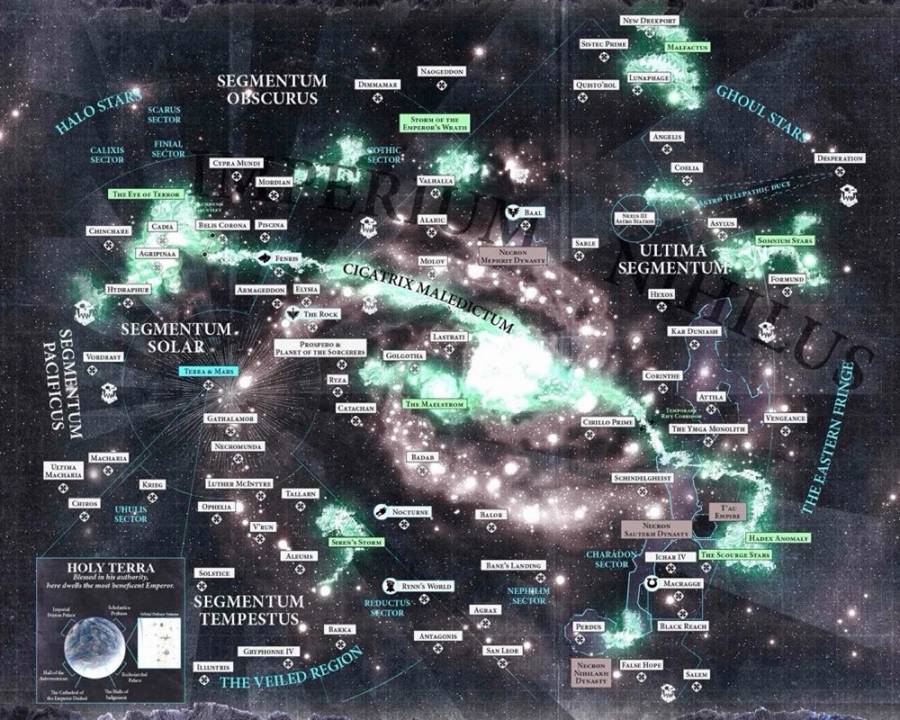
[edit]Tomb worlds lie across every segmentum, but the greatest concentrations known to the Imperium are in the Eastern Fringe and the eastern Ultima Segmentum, where the Sautekh and other dynasties are active, and in the region of the Ghoul Stars. Some are far from any Imperial world; others lie beneath hive worlds and colonies. Imperial cartographers believe the worlds identified so far to be only a fraction of the whole.[2]
| World | Region | Notes |
|---|---|---|
| Mandragora | Ultima Segmentum | Crownworld of the Sautekh Dynasty; seized by Imotekh the Stormlord in 781.M41 |
| Solemnace | Ultima Segmentum | World of Trazyn the Infinite, the Nihilakh Dynasty; avoided by Hive Fleet Behemoth in 745.M41 |
| Drazak | Ghoul Stars | Peopled by Flayed Ones |
| Damnos | Ultima Segmentum | Woke beneath an Imperial colony in 973.M41; contested by the Ultramarines until 999.M41 |
| Morrigar | Unrecorded | Hive world; a tomb woken by fighting between hive gangs in 805.M41 |
| Somonor | Unrecorded | Drawn into the Sautekh Dynasty in 798.M41 |
| Gehenna | Unrecorded | Held by the Silent King's forces; fought over at Devil's Crag in 955.M41 |
| Shemnoch | Unrecorded | Shemnoch Dynasty fought the Iron Hands in 900.M41 |
| Sanctuary 101 | Unrecorded | Adepta Sororitas mission destroyed in 897.M41 |
| Pavonis | Ultima Segmentum | Imperial world with a tomb beneath it |
| Selaaca | Veiled Region, Segmentum Pacificus | Its human population harvested by the Necrons |
| Rahe's Paradise | Unrecorded | Population destroyed by Exterminatus |
History
[edit]The first awakenings
[edit]The first tombs began to stir well before the Imperium knew what they were. An Imperial squadron was destroyed by Necron ships in the Yuctan System, near the Eastern Fringe, in 666.M41; at the time the attackers were not identified. In 781.M41 Imotekh the Stormlord took control of the Crownworld Mandragora and began the conquests that drew dozens of woken tomb worlds into the Sautekh Dynasty, among them Somonor in 798.M41. On the hive world Morrigar in 805.M41 a battle between hive gangs broke into a sleeping tomb and woke it; contact with the whole planet was lost.[5]
Contact
[edit]The Imperium dates its first true contact with the Necrons to 897.M41, when the Adepta Sororitas mission on Sanctuary 101 was wiped out by forces from the world's tomb. In the decades that followed, Imperial forces met woken tombs across the eastern Imperium: the Iron Hands fought the Shemnoch Dynasty in 900.M41;[b] the Blood Angels under Dante fought the Silent King's forces to a standstill at Gehenna in 955.M41; and on Damnos in 973.M41 a tomb woke beneath an Imperial colony and overran it, in a war that ran until the Second Battle of Damnos in 999.M41.[1][6][7]
Era Indomitus
[edit]The opening of the Great Rift and the turmoil that followed coincided with a sharp rise in the number of active tomb worlds. Ordo Xenos charts drawn after the Rift record dynastic territories in every segmentum, including worlds in Imperium Nihilus cut off from Imperial help. The Silent King Szarekh has returned and is gathering the dynasties into an alliance, and the Imperium holds him to be behind the Pariah Nexus, where tomb worlds and noctilith pylons have been used to cut a region of space from the Warp. Each tomb that wakes, Imperial savants warn, makes it more likely that its neighbours will wake as well.[2][8][9]
Timeline
[edit]| Date | Event |
|---|---|
| c. 60,000,000 years before M41 | The Great Sleep begins; the tombs are sealed[c] |
| 666.M41 | An Imperial squadron destroyed in the Yuctan System |
| 745.M41 | Two tendrils of Hive Fleet Behemoth turn aside from Solemnace |
| 781.M41 | Imotekh the Stormlord takes Mandragora |
| 805.M41 | Tomb of Morrigar woken |
| 897.M41 | Sanctuary 101 destroyed; first Imperial contact |
| 955.M41 | Battle at Devil's Crag, Gehenna |
| 973–999.M41 | Wars for Damnos |
| Era Indomitus | Widespread awakenings; the Pariah Nexus |
See also
[edit]
Notes
[edit]References
[edit]- ^ a b c d e f g h Codex: Necrons (5th edition). Games Workshop. pp. 14-15, 22, 82.
- ^ a b c d e Codex: Necrons (8th edition). Games Workshop. "A New Epoch: Foundation of Sand", p. 31.
- ^ a b c d e Codex: Necrons (3rd edition). Games Workshop. pp. 7, 19, 24, 58-59, 65.
- ^ White Dwarf 450 (January 2020). "Last of the Silent Kings". Games Workshop. pp. 28-33.
- ^ Codex: Necrons (5th edition). Games Workshop. pp. 5-53 (timeline).
- ^ Codex: Blood Angels (5th edition). Games Workshop. p. 16.
- ^ Apocalypse: War Zone Damnos (6th edition). Games Workshop. pp. 7-24.
- ^ Codex: Necrons (9th edition). Games Workshop. pp. 28-31.
- ^ Warhammer 40,000: Forgebane (8th edition, boxed set book). Games Workshop. p. 9.
Further reading
[edit]- McNeill, Graham. Nightbringer (novel). Black Library.
- Mitchell, Sandy. Caves of Ice (novel). Black Library.