
Narvhal
| Narvhal | |
|---|---|
| Navigator bio-ship of the Tyranids | |
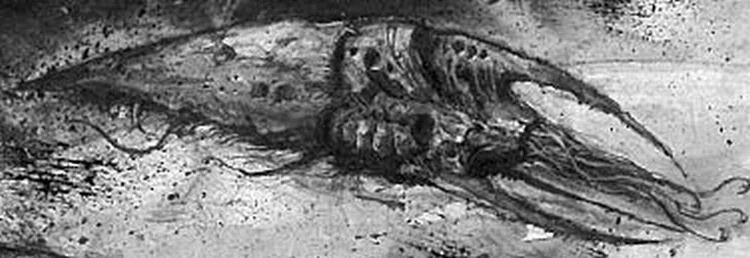 Magos Biologis sketch of a Narvhal Artwork © Games Workshop | |
| Operator |  Tyranid hive fleets |
| Type | Bio-ship; interstellar navigator |
| Classified by | Savants of the Imperium of Mankind |
| Propulsion | Compressed space-time corridor between star systems; reaction propulsion near stars |
| Sensors | Bow cluster of monofilament spines (gravimetric and electromagnetic) |
| Armament | Almost none |
| Defences | Thin carapace |
| Effects | |
| On target systems | Earthquakes, solar flares and tidal waves during a fleet's transit |
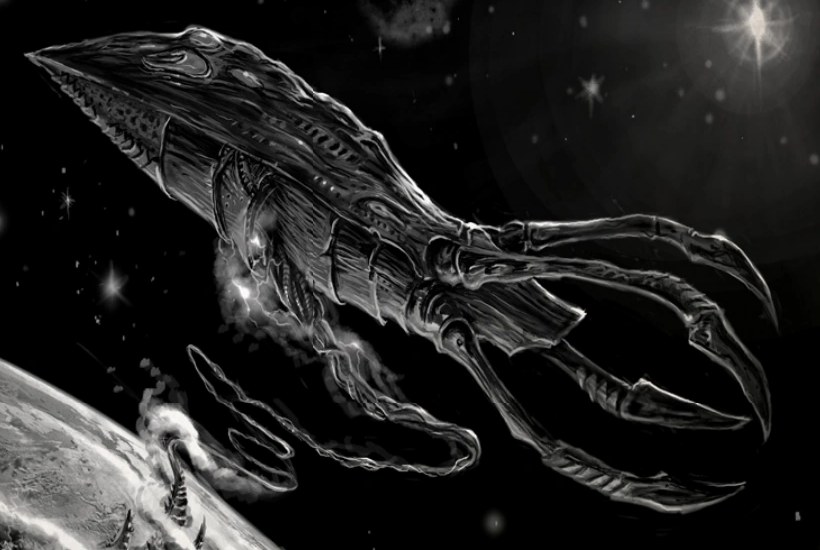
The Narvhal is a small Tyranid bio-ship that allows a hive fleet to travel between the stars. It does not use the Warp. Instead it bends space-time between the star system it leaves and the system it is heading for, opening a compressed corridor through which it and the rest of the fleet can pass. The savants of the Imperium of Mankind who classified it gave it its name.[1]
The Narvhal explains a long-standing puzzle. Hive fleets do not travel through the Warp as Imperial ships do, and some Imperial scholars argued that they had no means of crossing space faster than light. Yet the speed of their advance into the galaxy contradicts this. Imperial study concluded that hive fleets are confined to sublight speeds inside the gravitational bounds of a star system, but can move faster than light in the deep space between, and that the Narvhal is the reason.[1]
The method is slower than a Warp drive, but far more reliable, and it lets the hive fleets advance across the galaxy slowly and without pause. It also has dangerous side effects on the worlds the fleet is heading for.[1]
Biology
[edit]Unlike most Tyranid bio-ships, the Narvhal is almost defenceless. It has very little bio-weaponry and only a thin protective carapace. At its bow is a cluster of monofilament spines, which take in a wide range of sensory input, including gravimetric and electromagnetic signals across a broad spectrum.[1]
With these senses a Narvhal can detect new star systems at very great distances. In a manner not understood, it then uses the gravity of the star system it is leaving to create the transit corridor. The corridor cannot be formed close to strong sources of gravity, because they overwhelm the Narvhal's highly sensitive navigational senses.[1]
Effects on target worlds
[edit]The Narvhal's manipulation of a star's gravity can have unintended effects. While a hive fleet is passing through the corridor, a target world may suffer earthquakes, solar flares, tidal waves and other natural disasters.[1]
These disasters help the invasion. A world's defenders must spend their strength dealing with them, and when the swarm finally reaches orbit and the first mycetic spores begin to fall, the planet is already weakened. To a world's people the approach of a hive fleet may therefore be felt as a series of catastrophes before any Tyranid is seen.[1]
Arrival in a star system
[edit]Because the corridor cannot be held near a star, a hive fleet must cover the last stage of its approach to a new system using ordinary biological, reaction-based propulsion. This final approach can delay the fleet's arrival by years or even decades.[1] Inside the system the fleet moves at sublight speed under the direction of its Hive Ships, which act as the synapse nodes and bio-factories of the swarm.[2]
The fleet's psychic presence, the Shadow in the Warp, spreads ahead of it in the same period and blocks astropathic messages and Warp travel near it. A world in the path of a hive fleet can thus be cut off from help while the disasters caused by the Narvhal's corridor are still striking it.[3][a]
Place among the bio-ships
[edit]A hive fleet is an armada of living ships, each of which exists only as part of the greater entity that is the fleet.[3] The Narvhal is one of the smallest and most specialised. Others described in Imperial records include:
- The Hive Ship, the vast capital organism that coordinates the fleet and spawns its swarms.[2]
- The Kraken bio-ship, a family of escort-sized vessels that scout for the fleet and guard the Hive Ships. They were named after Hive Fleet Kraken, in which they were first documented, and Hive Ships have been seen giving birth to more of them during battle.[4]
- Cruiser-sized bio-ships such as the Razorfiend, thought to be overgrown escort drones or immature Hive Ships, which attack with claws and tentacles at close range. Because they are not synapse nodes, the fleet spends them freely.[5]
- Escort drones, which cluster around the flanks of the Hive Ships as their last line of defence.[6]
The Narvhal takes no part in battle. Its value lies wholly in carrying the fleet to its next world.[1]
History and current state
[edit]The first great hive fleet, Hive Fleet Behemoth, reached the galaxy in 745.M41.[3] The record does not say when Imperial savants first identified the Narvhal.[b]
The great hive fleets of the late 41st millennium, Hive Fleet Kraken (993.M41 by one record, with outlying tendrils reported c. 990.M41) and Hive Fleet Leviathan (997.M41), crossed interstellar space in the manner the Narvhal makes possible.[1][c] In the Era Indomitus the Imperium fights Hive Fleet Leviathan in the Fourth Tyrannic War, while other hive fleets strike worlds far from that front.[3]
See also
[edit]
Notes
[edit]- ^ The combination of the two effects is this archive's summary of the separate records.
- ^ The classification is recorded in Imperial literature of the late 41st millennium; the date of identification is unknown and is estimated as late M41.
- ^ The record describes the Narvhal as the means by which hive fleets in general cross interstellar space; it does not name particular fleets.
References
[edit]- ^ a b c d e f g h i j Codex: Tyranids (5th edition). Games Workshop. p. 19.
- ^ a b Battlefleet Gothic: Armada. Games Workshop. pp. 80–94.
- ^ a b c d "Hive Fleet". Warhammer 40k Wiki (Fandom).
- ^ "Kraken (Tyranid Ship)". Warhammer 40k Wiki (Fandom).
- ^ "Razorfiend Cruiser". Warhammer 40k Wiki (Fandom).
- ^ "Tyranid Escort Drone". Warhammer 40k Wiki (Fandom).