Wraithguard
| Wraithguard | |
|---|---|
| Ghost warriors of the Craftworld Aeldari | |
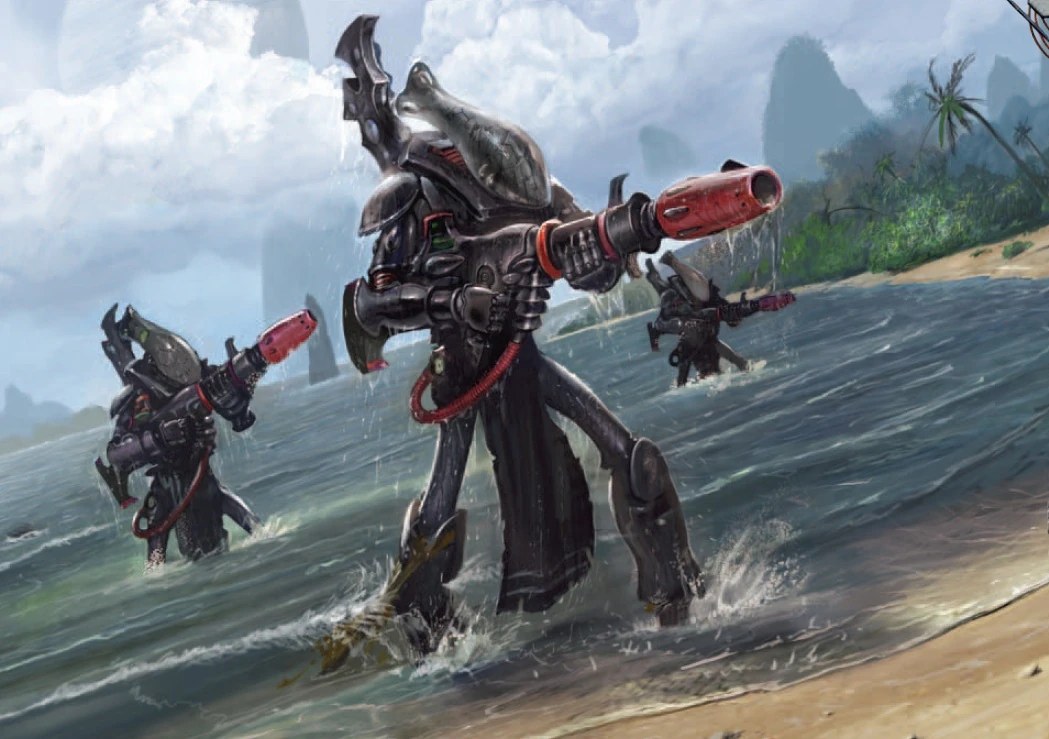 Wraithguard with wraithcannons advancing through shallow water Artwork © Games Workshop | |
| Allegiance | Asuryani craftworlds |
| Type | Wraithbone construct (ghost warrior) |
| Role | Heavy assault infantry, line-breakers |
| Size | Squads of five to ten |
| Animated by | The soul of a dead warrior held in a spirit stone |
| Led by | Warlocks and Spiritseers |
| Variants | Wraithblades (Klaivaulch) |
| Weapons | Wraithcannon, D-scythe, ghostswords, ghostaxe and forceshield |
| Notable users | Iyanden |
Wraithguard are war constructs of the Craftworld Aeldari. They are not living soldiers but tall bodies of wraithbone, the psycho-plastic material grown by the bonesingers of the craftworlds. Each is animated by the soul of a dead Aeldari warrior, drawn out of the craftworld's Infinity Circuit and set into a spirit stone in the construct's body. Together with the larger wraithlords they are known as the ghost warriors.[1]
The dead are woken for war only in times of great need, because the Asuryani are few and every living warrior lost is hard to replace. Wraithguard can suffer damage that would kill a living warrior and keep fighting, and so they are sent where living troops could not survive. Their usual weapon, the wraithcannon, tears open a small breach into the Warp that drags its target, or part of it, out of real space.[1]
The craftworld of Iyanden fields more of them than any other, having lost most of its living warriors to Hive Fleet Kraken in 992.M41.[1][2]
Nature
[edit]A wraithguard does not see as the living do. It perceives the world through the Warp, a sense called "wraithsight". Because the Warp is turbulent, the dead spirit often struggles to make out the true shape of the material world, and a construct can become confused or blind to what is around it. For this reason wraithguard are usually led into battle by warlocks who help to guide them.[1]
Iyanden trains psykers for this purpose alone. Called spiritseers, they are a branch of the warlocks who specialise in summoning and directing the dead. Other craftworlds regard the practice with distaste and call the spiritseers little better than necromancers, but tolerate it because their small numbers leave them no choice.[1][2]
Wraithblades
[edit]The most feared of the wraithguard are known as wraithblades. Few Asuryani will speak their true name, Klaivaulch, for fear of drawing the wrath of Khaine. By tradition each craftworld keeps them apart from other ghost warriors, so that the undying anger in their shells does not spread to spirits that might one day find peace again in the Infinity Circuit.[1]
Wraithblades are woken by the most gifted seers. Their spirit stones glow with heat as the anger of the dead rises, and once kindled that fury can only be spent in battle. They fight with paired ghostswords that leave glowing trails, or with a ghostaxe and a glowing forceshield that turns aside fire and blows. The Asuryani see in them the lives of their own people taken in the long struggle against extinction.[1]
Role in war
[edit]Wraithguard are committed in squads of five to ten and are often carried to battle in Wave Serpent transports. The wraithcannon has a short reach, but against infantry its effect is almost always fatal. Some squads exchange it for the D-scythe. Because their bodies are far tougher than living flesh, the craftworlds use wraithguard for tasks that would be suicide for living warriors.[1]
History
[edit]No record fixes the date at which the craftworlds first made wraith constructs. The practice is generally believed to date from the centuries after the Fall of the Aeldari at the end of the 30th millennium, when the survivors on the craftworlds were too few to defend themselves with the living alone.[a]
The heaviest use of ghost warriors in recent memory followed the attack of Hive Fleet Kraken on Iyanden in 992.M41. The craftworld was saved, but so many of its living warriors died that it has since relied on the dead to fight for it, and wraithguard and wraithlords make up a large part of its warhosts.[1][2]
In the Era Indomitus
[edit]No record describes a change in the making or use of wraithguard since the opening of the Great Rift in 999.M41. Iyanden and other craftworlds are understood to field them still.[b] A saying of the Iyanden spiritseer Iyanna Arienal, "Not even the dead have seen the end of war", is often quoted of them.[1]