
C'tan
| C'tan | |
|---|---|
| The Star Gods; Yngir in the Aeldari tongue | |
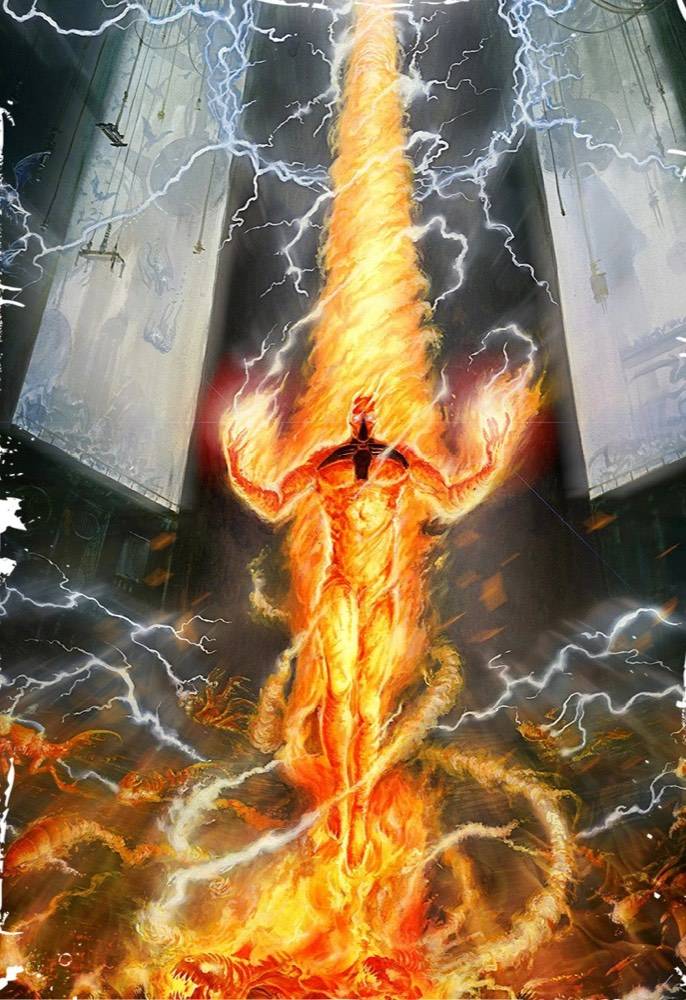 A C'tan shard freed from its tesseract prison, from an Ordo Xenos pict-record Artwork © Games Workshop | |
| Classification | Xenos: beings of living stellar energy, held in bodies of necrodermis |
| Origin | The birth of the universe; fed on the energy of stars |
| Servants | The Necrons, until the revolt of Szarekh |
| Enemies | The Old Ones and their servant races; later the Necrons; the Warp and its powers |
| Known C'tan | Mephet'ran the Deceiver; Aza'gorod the Nightbringer; Mag'ladroth the Void Dragon; Yggra'nya the World Shaper; Nyadra'zath the Burning One; Zarhulash the Potentate; N'phoran the Spiral Flame; Tsara'noga the Outsider; Llandu'gor the Flayer (destroyed); Iash'uddra, Og'driada and Kalugura |
| Fate | Broken into countless shards by the Necrons, c. 60,000,000 years before the 41st millennium (estimated); the shards are bound in tesseract labyrinths |
| Known weakness | The Warp, and a breach of the necrodermis shell |
The C'tan (pronounced ker-TAN), also called the Star Gods and known as the Yngir in the lexicon of the Aeldari, are held to be the oldest intelligent beings in the galaxy. They were born with the universe itself as entities of pure energy, and for ages they fed on the light of stars. In the reign of the Silent King Szarekh, sixty-odd million years before the 41st millennium, the Necrontyr gave the C'tan bodies of living metal, and the C'tan in return gave the Necrontyr immortality, which they paid for with their souls. With the C'tan on their side, the Necrontyr crushed the Old Ones in the War in Heaven.[1][2][a]
The bargain was a trap, and it was the Necrons who sprang the next one. As the war ended and the C'tan began to prey on one another, Szarekh led his people against their masters, using weapons that were made to kill gods. The C'tan were too much a part of reality to be destroyed, so each was broken into thousands of shards, and the shards were locked in tesseract labyrinths. Those shards, the C'tan shards, are what the Imperium and the Aeldari have since met in the galaxy: weapons of great power in the hands of the awakened Necron dynasties, and a danger to their keepers, since a shard that escapes will seek revenge.[1][3]
The C'tan are not creatures of the Warp, and the Warp is the one thing they cannot comprehend. They hate its powers and are vulnerable to its sorcery, and the Imperial scholars suppose that they set the Necrons to raise networks of blackstone pylons, on Cadia and across the Segmentum Obscurus, in order to seal the galaxy from it. Only a few of the Star Gods are known to the Imperium by name, the Deceiver, the Nightbringer and the Void Dragon among the greatest. In the Era Indomitus a number of shards have come into the wars of the Imperium, and in 999.M41 the Ultramarines of Marneus Calgar released one from its prison on Damnos.[3][4]
Nature
[edit]In their natural form the C'tan are vast beings of pure energy who spread themselves over the surface of a star and absorb its power. The Imperial scholars hold that they shortened the lives of the stars they fed on by millions of years, and that when a star died they moved on to another on wings of electromagnetic force. Matter, planets and nebulae were beneath their notice, because the energy of such things was too small to register on their hunger. They paid no heed to the creatures who lived on those planets until the Necrontyr offered them bodies.[1][5]
A C'tan can act in the material universe only through a body. The Necrontyr made such bodies of necrodermis, the living metal of their torch-ships, in the likeness of the half-forgotten gods of their own culture, and the C'tan poured themselves into them. In the physical form the C'tan acquired the hungers and the cruelty of the beings that their worshippers took them for. The energy of stars tasted of nothing to them, and the life of mortal beings was delicious. They were never again content with the light of suns.[1][5]
The only way to defeat a C'tan, or a shard of one, is to breach its shell of necrodermis. If the shell is broken, the shard explodes in a pulse of energy that scatters its essence into the solar wind. Otherwise a shard can do almost anything: it can unleash energy, control the minds of lesser creatures, bend the flow of time and banish its enemies to other dimensions. Its power is limited only by its imagination, which is immense, and by the dim memory of the greater being from which it was cut.[1][3]
History
[edit]The Star Gods and the Necrontyr
[edit]The C'tan were formed in the first moments of creation, out of the energies of the cooling universe, and for an immeasurable time they were little more than parasites on the stars that had made them. Far away, on a world under a scourging sun in the Halo Stars, the Necrontyr lived and died quickly. Their cities were built for the dead, their dynasties were founded on the expectation of early death, and when they took to the stars they carried their grievance with them. They met the Old Ones, who were immortal, and were told that the secret of long life would not be shared with them. The Necrontyr were bitter, and then they were divided: each dynasty sought its own fate, and the empire was torn by the Wars of Secession.[1][2]
To end the wars the Triarch, the ruling council headed by the Silent King, proclaimed a war against the Old Ones, and the Necrontyr fought it for ages. They lost it. The Old Ones' mastery of the Webway and the Warp was too much for them, and the Necrontyr were driven back to their homeworld. The Wars of Secession broke out a second time, worse than the first. It was at this time that the Necrontyr found the C'tan. The accounts differ. The archives of Solemnace say that it was an accident of an astronomical probe, the sealed Book of Mournful Night holds that the Necrontyr hatred of the Old Ones was a beacon that the C'tan could not ignore, and another account that the Necrontyr scientists, in their study of their own sun, found the C'tan in the plasma of dying stars.[1][6]
The pact
[edit]One C'tan came before Szarekh as the forerunner of its kind. It was called the Deceiver among them, for it lied by habit. It told the Silent King that the C'tan had fought and lost a war against the Old Ones before the Necrontyr existed, that they had hidden from the Old Ones' revenge, and that they sought allies. In return for the Necrontyr's help the C'tan would give unity and immortality, and ask for nothing. Only one voice opposed it. The astrologer Orikan foretold that the alliance would bring a renaissance of glory and ruin the soul of his people forever, and his prophecy was ignored. A Necrontyr year after the Deceiver's proposal the Triarch agreed.[1][5]
The C'tan took their bodies and were worshipped as gods, and they soon proved as cruel and capricious as the stars that gave them birth. They revelled in the Necrontyr's worship and fed on the life energies of mortal slaves. They also offered the Necrontyr the physical stability that their race had always craved, and the Necrontyr paid for it.[1]
Biotransference
[edit]The C'tan taught the Necrontyr the process of biotransference, in which colossal bio-furnaces consumed their flesh and replaced it with necrodermis, as the C'tan's own bodies were made. The Star Gods swarmed over the furnaces and drank the souls that were cast off, growing stronger with each. Szarekh himself passed through the furnaces and understood only afterwards what had been done: he was stronger and clearer in mind than before, but there was a hollowness in him that he could not explain, and his soul had been drunk by a circling C'tan. The Necrontyr had become the soulless Necrons, and the command protocols that biotransference had set in every mind gave Szarekh perfect obedience from his people.[1][5]
The War in Heaven
[edit]With the C'tan and the Necrons at war together, the Old Ones were doomed. Planets were razed and suns put out, and star systems were swallowed by black holes. The C'tan called Nyadra'zath, the Burning One, had long wanted to carry his fires into the Webway, and he showed the Necrons how to breach it through the living stone portals known as Dolmen Gates. With them the Necrons turned the Old Ones' greatest work against them. The younger races that the Old Ones had nurtured became cattle for the C'tan, and the Necron armies harvested them in "red harvests".[1][6]
The C'tan began to fight among themselves, for sport and from spite. The Aeldari tell that their Laughing God, Cegorach, tricked the C'tan known as the Outsider into devouring its brothers and starting the fratricidal war, and that the Harlequins dance the moment, though in their dance the victim is the Nightbringer. Whole planets were destroyed in the C'tan's struggle against one another, until only a few were left. The Old Ones, losing, bred new races with a stronger link to the Warp, among them the earliest of the Aeldari, the Krork and many others, and these psychic armies broke the C'tan empire, because the Warp was anathema to the C'tan.[1][5]
The C'tan, united for the first time in millions of years by the threat, began a work to seal the region from the Warp, of which the blackstone pylons of Cadia are held to be the first fruits. But the Old Ones' creations had seeded the Warp with the passions of mortals, and the carnage of the war drove them into the Realm of Chaos. Daemons, and the Enslavers, appeared, and the Old Ones were scattered and destroyed. Whether they are extinct or left the galaxy is not known.[1][6]
The revolt of the Silent King
[edit]Szarekh waited. He could not defeat the C'tan at the height of their power and could not hope to finish the war with the Old Ones if he tried. When the Old Ones were beaten and the C'tan were spent from victory, he led the Necrons in revolt. The Crypteks had made god-killing weapons, among them hypercannons, that even the Star Gods could not bear. Causality itself was damaged, and the Silent King afterwards took the knowledge of the weapons from the minds of his warriors, for fear of what might be done with it. A C'tan could not be destroyed, because it was part of the fabric of reality, so it was cut into thousands of shards, and each shard was bound in a multidimensional tesseract labyrinth. The victory cost the Necrons millions of their number and every member of the Triarch but Szarekh.[1][5]
C'tan shards
[edit]A C'tan shard is what is left of a C'tan: an echo and a fragment, enslaved in turn by the Necrons. Most are bound to obey their masters and cannot act without orders. If a shard rebels or its control relays fail, fail-safe mechanisms return it to its tomb, where it sleeps until the Necrons need it again. They are used sparingly. The Necrons know that the chance of escape is small but real, and the day must be dark for their cause before the labyrinths are opened. Each shard carries the character and the pride of the whole, and it may therefore overlook the simple answer, such as reducing a tank to slag, if the original would have chosen a subtler way, such as turning the crew against each other.[3][1]
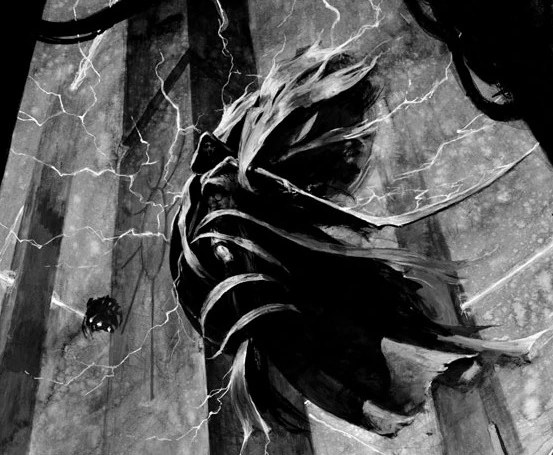
The Aeldari have catalogued the powers of the shards: gathering antimatter into meteors, calling pillars of black fire, rotting metal at a touch, draining life with a gaze, weaving glamours that hide the Necron army, tearing up the ground, and casting a foe out of existence by remoulding the flow of time. A shard can use two of these at a time. The Aeldari also note that the C'tan cannot be counted: archives differ, and there may be four or four thousand left in the galaxy. Any being with unexplained powers, daemon or alien, can be taken for a C'tan by the credulous, which has made the Imperial record of them unreliable, and the Aeldari hold the Imperium's lists to be worse than useless.[3][1]
Transcendent C'tan
[edit]A Transcendent C'tan is the most dangerous kind of shard, an aggregation of between a dozen and a hundred lesser shards whose power exceeds the sum of its parts. Such a being is not held in a tesseract labyrinth but by shackles of energy devised by the Necron artificer Svarokh, and these are unstable, so a Transcendent C'tan is not set loose without the device known as a Tesseract Vault. In the vault it is kept in an energy shield generated by a Canoptek Sentinel, while Canoptek Leeches and swarms of Scarabs repair the damage it does to its prison as it bends reality and tears at the metal.[3]
The known C'tan
[edit]The Imperium and the Aeldari know the names of many of the C'tan, though only some of them are seen. The Nightbringer, Aza'gorod, has set his image on the minds of the younger races as the figure of death itself; only the Orks, who do not fear it, are untouched. The Imperial records say that when it entered stasis it was almost starved and destroyed, and that a corrupt administrator, Kashmir de Valtos, released it in the 41st millennium, which began the awakening of the Necrons. The Deceiver, Mephet'ran, woke at some unknown time and has been scheming since, and among his works is the destruction of the Old Ones' weapons that the Aeldari call the Talismans of Vaul and the Imperium the Blackstone Fortresses, which were meant to destroy the C'tan on their emergence.[3][7]
The Void Dragon, Mag'ladroth, is reckoned the most powerful of them all. It is theorised to lie in stasis beneath Mars, in the Noctis Labyrinthus, and some tech-priests believe that it is the Machine God that the Adeptus Mechanicus venerate. No shard of the Void Dragon has been seen, and it may have remained whole through the ages, which would be a dreadful thing to wake. Tsara'noga, the Outsider, was driven mad by the Laughing God's trick, and its presence causes madness in all who come near it; it is held, by some accounts, in a Dyson sphere beneath the galactic plane, and the Harlequins whisper that it will return. Llandu'gor, the Flayer, was not shattered but destroyed in the revolt, and cursed the Necrons with an echo of its hunger, the madness of the Flayed Ones.[3][5]
Others are known by name only. N'phoran the Spiral Flame appeared on the battlefield when the nemesor Yhardusz unleashed it against the Tyranids. Iash'uddra the Endless Swarm and Og'driada the Arisen are known to exist, and nothing more. Kalugura, a horrific engine of destruction, was imprisoned on the world that bears its name at the command of Szarekh for a reason that is not recorded. Yggra'nya the World Shaper, who can break planets and remould them, ruled the mobile tomb world Borsis in the old time, and a great shard of it powered Borsis as the World Engine, which the Necron lords Turakhin and Heqiroth woke in 912.M41 and sent against Mars to rouse the Void Dragon. Zarhulash the Potentate was the power source of one of the eight Pharos beacons on Sotha.[3][8]
The C'tan in the Era Indomitus
[edit]Since the opening of the Great Rift the Necrons have come out of their tombs in great numbers, and the shards have come with them. In 999.M41, in the second battle of Damnos, the Ultramarines of Chapter Master Marneus Calgar were at a stalemate with the Necrons when the Chief Librarian Varro Tigurius told him that the Tesseract Vault that was attacking them held a C'tan. Calgar ordered his Chapter's fire upon the vault, and a shard of Yggra'nya burst out and opened great chasms in the planet. Captain Cato Sicarius hurled a vortex grenade into it, and the shard was pulled into the Warp, which the C'tan cannot endure.[4]
In the same age the archmagos Belisarius Cawl led an expedition to Sotha to use the Pharos of that world against the Great Rift. He found that its heart was a shard of Zarhulash, and bargained with it: if Zarhulash destroyed the machine, Cawl would break its shackles and open a portal for it. Cawl kept the first half of the pact and not the second, and sent the shard to a region of the galaxy surrounded by hostile tomb worlds. Zarhulash swore vengeance. The Necrons themselves have been drawn into a civil war over the return of Szarekh, and the pylons of the Pariah Nexus that the war is fought over are a work of the same hatred of the Warp that the C'tan held.[9][10]
Other traces of the C'tan
[edit]The Imperial Officio Assassinorum has had dealings with objects of the C'tan's making. The Callidus assassins carry a phase sword, of a metal that resembles necrodermis, and in one recorded case a Callidus who struck at a planetary governor had her weapon absorbed into the body of the man, who was most likely the Deceiver in one of its many disguises. There is also a Necron object of unknown purpose in the equatorial jungles of Armageddon. The Imperium knows little else of the C'tan, and what it knows, it has learned in blood.[3][5]
Timeline
[edit]| Date (estimated) | Event |
|---|---|
| The birth of the universe | The C'tan arise as beings of stellar energy and feed on stars |
| Before c. 65,000,000 years before M41 | The Necrontyr are refused immortality by the Old Ones and fall into the Wars of Secession |
| c. 65,000,000 years before M41 | The Deceiver comes before Szarekh; the Triarch accepts the pact |
| c. 65,000,000 years before M41 | Biotransference makes the Necrontyr into the Necrons; the C'tan feast on their souls |
| c. 65–60,000,000 years before M41 | The War in Heaven: the C'tan and the Necrons breach the Webway and crush the Old Ones' empire |
| c. 60,000,000 years before M41 | The Old Ones fall; the Necrons revolt and break the C'tan into shards |
| 41st millennium | Kashmir de Valtos frees the Nightbringer, and the Necrons begin to wake |
| 912.M41 | The World Engine of Borsis, powered by a shard of Yggra'nya, marches on Mars |
| 999.M41 | A shard of Yggra'nya is loosed in the second battle of Damnos |
| Early M42 | Belisarius Cawl bargains with Zarhulash on Sotha |
See also
[edit]
Notes
[edit]- ^ Dates before the Great Crusade are estimates; the Aeldari and Necron records disagree by millions of years.
References
[edit]- ^ a b c d e f g h i j k l m n o p Codex: Necrons (7th edition, digital edition). Games Workshop. pp. 8-9, 159-162, 178-179.
- ^ a b "The Necrons". White Dwarf 191 (UK). Games Workshop. pp. 49-53.
- ^ a b c d e f g h i j Codex: Necrons (8th edition). Games Workshop. pp. 69, 100, 113.
- ^ a b Apocalypse: War Zone Damnos (6th edition). Games Workshop. pp. 20-21, 24, 35. Apocalypse (6th edition). Games Workshop. pg. 174.
- ^ a b c d e f g h Codex: Necrons (3rd edition). Games Workshop. pp. 24-31.
- ^ a b c Codex: Necrons (5th edition). Games Workshop. pp. 5-8, 40-41.
- ^ Kelly, Phil. "Worlds of Warhammer". White Dwarf 40 (December 2019). Games Workshop. pg. 11. Codex: Eldar (2nd edition). Games Workshop. pg. 83.
- ^ Counter, Ben. The World Engine (novel). Black Library. chs. 3, 6, 9, 15. Goulding, L.J. "The Lords of Borsis" (short story). Black Library.
- ^ Haley, Guy. Belisarius Cawl: The Great Work (novel). Black Library. chs. 8, 9, 23, 26.
- ^ "Pariah Nexus". Warhammer 40k Wiki (Fandom).