Necron Overlord
| Necron Overlord | |
|---|---|
| Ruling rank of the Necron nobility | |
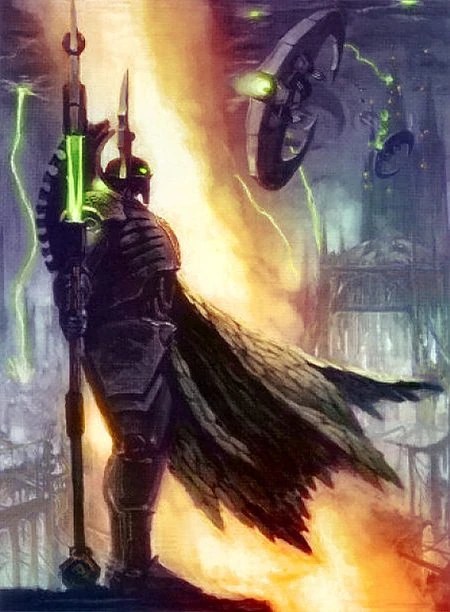 Imotekh the Stormlord, phaeron of the Sautekh Dynasty and the best known of all Overlords Artwork © Games Workshop | |
| Rank | Above a Necron Lord; below or equal to a phaeron |
| Rules | Crownworlds and important coreworlds; a phaeron rules a whole dynasty |
| Court | Lesser nobles, Crypteks, bodyguards |
| Typical arms | Staff of light, warscythe, tachyon arrow |
| Female form | Phaerakh (for a phaeron) |
| Notable holders | Imotekh the Stormlord, Trazyn the Infinite, Szarekh, Hapthatra, Mesophet, Zahndrekh |
A Necron Overlord is one of the highest nobles of the Necrons. An Overlord rules one or more Tomb Worlds and commands legions of warriors, war engines and ancient weapons. Overlords outrank the ordinary Necron Lords, and the most powerful of them, the phaerons (female phaerakh), rule entire dynasties that may span a sector or more.[1]
Overlords are the most dangerous Necron commanders the Imperium faces. Their bodies are the finest the Necrons ever built, proof against anti-tank weapons and strong enough to crush plasteel. Unlike most of their subjects, they kept their memories and personalities when they passed into machine bodies. That survival makes them brilliant strategists, and it also preserves their ambitions, feuds and, in many cases, their madness.[1]
History
[edit]Nobility of the Necrontyr
[edit]The Overlords descend from the ruling class of the Necrontyr, the short-lived people who later became the Necrons. When the Necrontyr accepted biotransference from the C'tan during the War in Heaven, in the distant past before the Great Sleep, the nobles fared far better than the lower classes. Their engram circuits kept their whole selves, while most commoners woke as dull-witted soldiers with little memory of who they had been.[1][a]
Awakening
[edit]After the Great Sleep, the dynasties began to wake across the galaxy during the Imperium's age, and with them their Overlords. Each Tomb World may hold dozens or even hundreds of nobles, but only one has absolute rule. Most coreworlds and fringeworlds are ruled by a Lord. Crownworlds and the most important coreworlds are ruled by an Overlord.[1]
Waking is seldom clean. Even a minor fault in the stasis process can change a noble's personality or perception of the world. Some Overlords wake with their old quirks exaggerated. Others suffer outright delusions, and the Destroyer Lords are the most extreme cases of the sickness.[1]
Era Indomitus
[edit]The return of Szarekh, the Silent King, at the end of the 41st millennium changed the position of many Overlords. Two minor phaerons, Hapthatra and Mesophet, proved their loyalty to him by swift service and were raised to his Final Triarch. Their dynasties were folded into his own Szarekhan Dynasty, and Hapthatra took the title "Phaeron of the Stars" and Mesophet "Phaeron of the Blades".[1][b]
Role and court
[edit]Every Lord and Overlord keeps a royal court of lesser nobles bound by fealty, Crypteks in their service, and sometimes trusted bodyguards. These courts are full of intrigue, though it moves at a slow pace by human standards. Necrons calculate before they act, and a pretender seldom moves against a ruler unless the odds favour him. An Overlord who cannot win may even yield to a rival and wait centuries at a lower rank for the chance to take power back.[1]
When such disputes become open war, the nobles take sides and fight by the formal codes of the ancient Necrontyr, with set-piece battles whose terms are agreed in advance. Because Necron bodies repair themselves, such wars can last years or centuries without a result, and most nobles avoid them.[1]
The same codes are rarely extended to other species. Most Overlords see the younger races as vermin squatting on Necron worlds, and they use ambush and assassination against them, methods forbidden in wars between Necrontyr nobles. Even so, an Overlord leads from the front whenever he can, to prove his right to rule to his peers and his enemies alike. Overlords also take a hand in delicate operations, such as sabotage against a rival or the planting of mindshackle scarabs on a curious Inquisitor.[1]
Phaerons
[edit]A phaeron is an Overlord who rules an entire dynasty, with a court of lesser Overlords beneath him. Very large dynasties may have several phaerons serving a greater one, as in the Szarekhan Dynasty. Imperial observers report that a phaeron's will is so strong that nearby Necrons fight with a share of it. The best known is Imotekh the Stormlord, who rules the eighty Tomb Worlds of the Sautekh Dynasty.[1]
Wargear
[edit]Overlords favour weapons that show their rank. The staff of light is the most common, alongside warscythes, tachyon arrows and heavy gauntlets that burn with green fire. Their minds can weigh possible outcomes faster than any Imperial autosavant, which lets them make tactical decisions while fighting in person.[1]
Notable Overlords
[edit]- Imotekh the Stormlord, phaeron of the Sautekh Dynasty.
- Trazyn the Infinite, Overlord of Solemnace and collector of artefacts.
- Szarekh, the Silent King, last ruler of the Triarch.
- Zahndrekh, Overlord of Gidrim and vassal of the Sautekh Dynasty.
- Aznibal of the Hapset Dynasty, who drew the Magos Tezler into heresy beneath the forge world Eucopia and was destroyed there in 992.M41 by Ciaphas Cain, loyal tech-priests and the Reclaimers Chapter.
- Xun'bakyr, phaerakh of the Maynarkh Dynasty, called the Mother of Oblivion.
Timeline
[edit]| Date | Event |
|---|---|
| Before Imperial dating | Biotransference; the nobles keep their minds and become Lords and Overlords[a] |
| Imperial age | Tomb Worlds wake and their Overlords resume rule |
| 992.M41 | Overlord Aznibal is destroyed beneath Eucopia |
| Late M41 | Szarekh returns; Hapthatra and Mesophet join the Final Triarch[b] |
See also
[edit]Notes
[edit]- ^ a b The War in Heaven and the Great Sleep predate Imperial dating. Imperial scholars place them some sixty million years before the present; this figure is not given in the reference article and is unverified.
- ^ a b The reference article dates Szarekh's return to 744.M41. Other Imperial accounts tie it to the opening of the Great Rift around 999.M41. The earlier date is treated here as unverified.