
Razorback
| Razorback | |
|---|---|
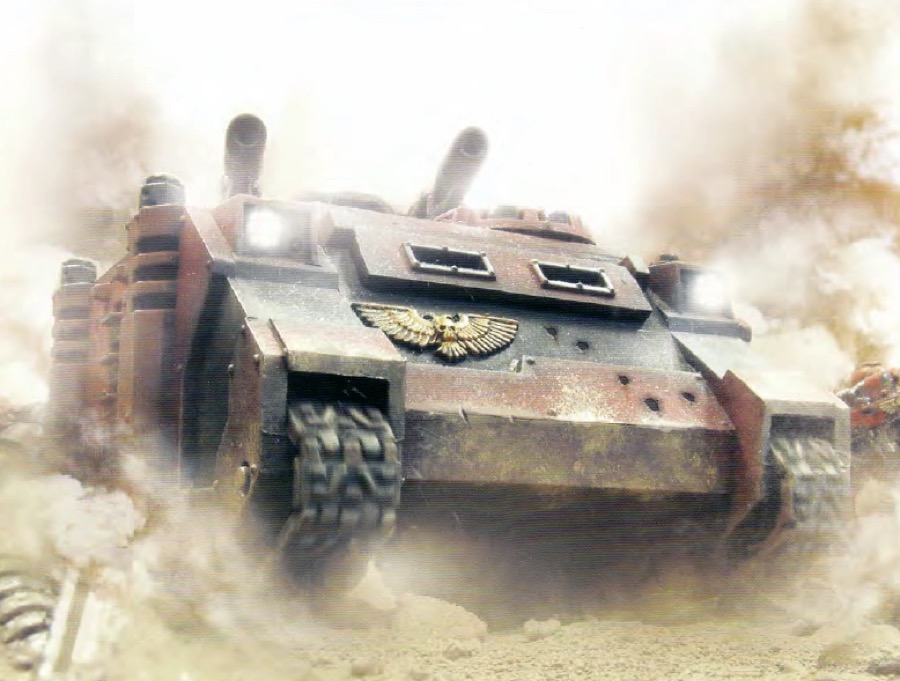 A Razorback with twin-linked lascannons Artwork © Games Workshop | |
| Type | Armoured personnel carrier, fire support |
| Users | Adeptus Astartes, Inquisition, Adeptus Arbites |
| Chassis | Rhino |
| Design recovered | M36 by Chief Artisan Tilvius (estimated) |
| Capacity | Six battle-brothers |
| Standard weapon | Twin-linked Heavy Bolters |
| Alternatives | Lascannons, Heavy Flamers, Assault Cannons, Multi-melta, Plasma Guns |
The Razorback is an armoured personnel carrier used mainly by the Chapters of the Adeptus Astartes, and also by the Inquisition and the Adeptus Arbites. It is a variant of the Rhino chassis that gives up part of the troop space in order to carry a remote-controlled weapon on the roof, usually twin-linked heavy bolters or lascannons.[1]
Unlike the Rhino, which has no more than a pintle-mounted storm bolter, the Razorback can stay on the field after landing its cargo and serve as heavy fire support. The range of turret weapons lets it be used against targets from light infantry to heavy armour.[1]
History
[edit]The design was recovered from an Standard Template Construct database found in the 36th millennium in the Southern Rim by Chief Artisan Tilvius. A second template was found at the same time, but its schematics were never put into production. After nearly two hundred Terran years of field trials, Tilvius gave the full template to Mars, with records showing that the Razorback had carried Human troops in the Age of Technology.[1][a]
The Adeptus Mechanicus judged the omens good and approved the template, and production began on the Forge worlds. Imperial scholars had long suspected that a troop-carrying form of the Predator existed. The Razorback fits that description, and its extra firepower filled the place left when the Predator became a pure battle tank.[1]
Design and use
[edit]The turret is controlled from inside through the same logic-engine as the Land Raider, which cuts the crew to one, though a second crew member can help when the driver is busy. Older patterns have a manned weapon. The Razorback carries six battle-brothers.[1]
Standard doctrine places Razorbacks as fire support alongside Rhinos or infantry in an assault, since even a single Razorback escort sharply improves a strike. Some Chapters use them as mobile command posts or as the screen for heavy reconnaissance with bikes and attack bikes. Some Chapter Masters say that it fails both as a transport, since it cannot carry a full squad, and as a tank, since it lacks armour and heavy weapons.[1]
Armament and patterns
[edit]Because the Razorback is a newer design than the Rhino and Predator, it has less sanctity and fewer taboos against change. It has the largest range of weapon options of any Space Marine vehicle, and many Chapters add unapproved weapons that then spread to others. Alongside twin heavy bolters and twin lascannons, it can mount twin heavy flamers, twin multi-meltas or a single multi-melta. The Blood Angels fit twin assault cannons or a flamestorm cannon, and the Grey Knights and Ordo Malleus use a pattern with twin Psycannons.[1][2]
The Infernum Pattern, a multi-melta variant, is used by some Chapters of the Segmentum Tempestus. The Fire Hawks used it in the Badab War. The Vortimer Pattern was made by the Grey Knights' Master Armourer Regis Vortimer for the Deliverance of Vulgate, and each deployment needs the sanction of the Chapter Council. The oldest pattern, the Mark 1 Stronos, carried twin plasma cannons and a lascannon. Production stopped for reasons that are unknown, and the records on it are sealed.[1]
Timeline
[edit]| Date | Event |
|---|---|
| M36 (est.) | Standard Template Construct for the Razorback is recovered by Chief Artisan Tilvius |
| Late M36 to early M37 (est.) | After nearly two centuries of trials the Adeptus Mechanicus approves production |
| Late M41 | The Razorback serves in most Space Marine Chapters |
See also
[edit]

Notes
[edit]- ^ The sources give only the 36th millennium. The field trials ran for nearly two centuries after the recovery, so the approval falls in the later part of M36 or the early part of M37. The date is inferred.