
Cruiser
| Cruiser | |
|---|---|
| Medium capital warship of void fleets | |
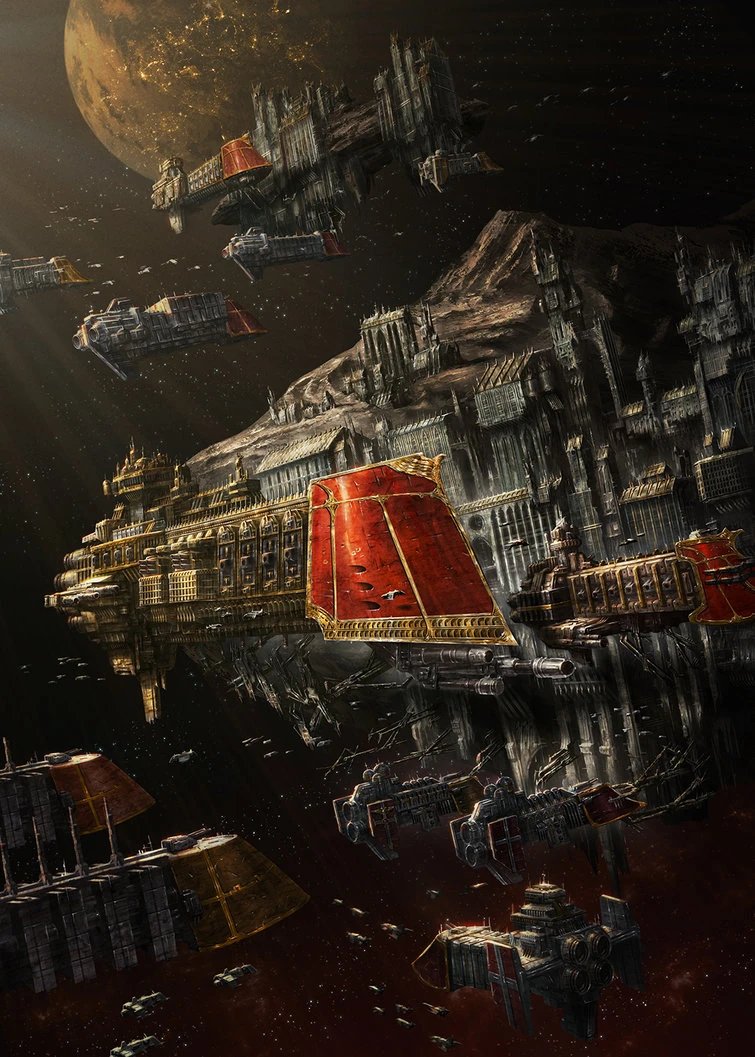 Cruisers and escorts of the Imperial Navy leaving an orbital anchorage Artwork © Games Workshop | |
| Type | Capital ship |
| Length | Commonly 4–6 kilometres |
| Crew | Tens of thousands |
| Role | Patrol, raiding, blockade, line of battle in support of battleships |
| Sub-types | Light cruiser, standard cruiser, heavy cruiser, battlecruiser, grand cruiser, strike cruiser |
| Used by | Imperial Navy, Adeptus Astartes, Adeptus Mechanicus, Rogue Traders, Chaos Space Marines, Aeldari, Necrons, Orks, T'au, Tyranids |
| First major use | The Great Crusade, 31st millennium |
A cruiser is a void-going warship of middle size, larger and more powerful than an escort and faster and more manoeuvrable than a battleship. Cruisers are the backbone of almost every starfaring fleet. They have the firepower to win most engagements and the speed to reach them, so they are sent on nearly every kind of duty: patrol, blockade, raiding, convoy protection and the line of battle itself.[1]
The term covers a family of hull types that differ in size and purpose. The light cruiser trades armour and guns for speed. The standard cruiser balances the two. The heavy or armoured cruiser favours defence and firepower, and the most heavily gunned of these are called battlecruisers. The largest are the ancient grand cruisers, which come close to the power of a battleship. The Adeptus Astartes use their own family of fast assault vessels, the strike cruisers.[1]
Imperial cruiser design dates from the Great Crusade of the 31st millennium, when the expeditionary fleets needed warships by the thousand. In the 41st and 42nd millennia, classes such as the Lunar, Gothic and Dauntless remain the most common capital ships in the battlefleets of the Imperial Navy.[2]
Design and history
[edit]Origins in the Great Crusade
[edit]The conquest of the galaxy in the Great Crusade (c. 798.M30–005.M31) demanded ships that could carry armies, deliver ruinous firepower and survive the passage of the Warp and the strain of the deep void. New warships were needed to replace losses and to meet the growing demands of the expeditionary fleets, the Armada Imperialis of the Imperial Army, the Rogue Traders and the defence navies of individual star systems. The forge yards answered with a great variety of classes, each built for a particular tactical role.[3]
In Great Crusade practice, light and heavy cruisers were warships of roughly four to six kilometres in length with crews in the tens of thousands. They were intended for independent operations, such as raids, assaults on outposts, deep-range patrols and search-and-destroy sweeps, and for service as the working warships of larger fleets and squadrons.[3] The cruiser hull was also cheaper than that of a battleship, and so it was adapted to a long list of rarer roles. Siege monitors, attack carriers, pursuit cruisers, torpedo rams, claw-cruisers and shield-barques all appear in the order of battle of the ancient Armada Imperialis, and a few survive as relics in Chapter fleets and in the Navis Imperialis.[1]
Hull types
[edit]Light cruisers are often treated as scouts and heavy escorts. Some forge worlds, however, build slower, better-armoured "pocket cruisers" as a cheaper alternative to a full cruiser. They are easy to maintain and need fewer crew, which makes them attractive to Rogue Trader dynasties.[1] Imperial records describe hundreds of different light cruiser patterns in service, against only a few dozen approved patterns from which all heavier cruiser classes derive.[4]
Standard cruisers are the principal combat vessels of the battlefleets. Most Imperial classes share the same general hull and differ in the mix of broadside batteries, lance turrets, torpedo tubes and launch bays they carry. A cruiser of the same class may look very different depending on the yard that built it: a Lunar laid down above Cypra Mundi can bear little resemblance to one built at Kar Duniash or in the Ring of Iron of Mars, yet both share the same operating characteristics and can be serviced at any Imperial dock.[2]
Heavy cruisers are similar in size to standard cruisers. The difference lies in their role: they are designed to favour defence and firepower over speed.[1]
Grand cruisers were once the core of battlefleet squadrons and were built for long independent deployments or to carry a specialised weapon. Their advanced Warp drives became poorly understood by the Adeptus Mechanicus, and several were lost to Warp disasters. Many senior officers of the Navy now regard them as dangerous and of doubtful technology, and the survivors are mostly held in the segmentum reserve fleets at Departmento Munitorum depot worlds.[1]
The battlecruiser arose from the failure of the grand cruiser. After skills needed to maintain the older ships were lost in the Age of Apostasy of the 36th millennium, the tech-priests of the Adeptus Mechanicus combined the simpler systems of later cruisers with battleship power plants. The first battlecruisers were built in the late centuries of the 36th millennium.[1][a] The galleass of war is a vessel with the fighting power of a grand cruiser but much of its hull given to cargo and transport. It served as the flagship of the most powerful early Rogue Traders and survives only as a rare relic.[1]
Role in fleets
[edit]No cruiser can match a true battleship in an equal fight. In a fleet action, cruisers support their own battleships and battle-barges: they use their speed to strike the enemy's flanks, combine their fire on single targets and finish off damaged ships of the line.[1] Outside the great battles they carry most of the Navy's daily work. Cruisers usually operate in pairs, which doubles the firepower brought to bear and forces an enemy to divide its fire.[5]
Cruisers can be built at many more yards than battleships. It is not unusual for them to be constructed above smaller forge worlds or any civilised world with a large enough orbital dock. The Lunar-class Lord Daros was famously built above the feral world of Unloth from metal mined by its tribes over eleven years.[2][b]
Standard cruisers are seldom held by Rogue Traders, but grand cruisers are surprisingly common in the fleets of the wealthiest dynasties, because battlefleet lord admirals are often glad to sell what they see as costly and hazardous antiques.[1]
Imperial classes
[edit]The main Imperial cruiser classes are listed in Imperial Navy ship classes. Among the most common are:
- Standard cruisers: Lunar, Gothic, Dominator, Dictator, Tyrant
- Light cruisers: Dauntless, Endeavour, Endurance, Defiant
- Battlecruisers: Mars, Overlord, Armageddon
- Grand cruisers: Vengeance, Avenger, Exorcist
Other powers
[edit]Every void-faring power fields ships of cruiser size. Chaos fleets use the Murder, Slaughter, Carnage and Devastation classes, many of them Imperial hulls lost to treachery. The Aeldari fly the Eclipse and Shadow classes, the Necrons the Shroud and Scythe vessels, and the Orks the kill kroozer. The T'au, the Leagues of Votann and the Tyranids each field their own equivalents.[1]
In the Era Indomitus
[edit]Cruisers remain the bulk of the Imperial Navy's capital ships in the Era Indomitus. The fleets of the Indomitus Crusade, raised from 999.M41 onward, were built around existing Imperial designs, and no record describes a new cruiser hull type adopted since the opening of the Great Rift.[c]
Timeline
[edit]| Date | Event |
|---|---|
| Late M30–early M31 | Great variety of cruiser classes built for the Great Crusade |
| M36 | Skills to maintain grand cruisers lost in the Age of Apostasy |
| Late M36 | First battlecruisers built by the Adeptus Mechanicus |
| 139–160.M41 | Cruisers bear much of the fighting of the Gothic War |
| 999.M41 onward | Cruisers serve in the fleets of the Indomitus Crusade |
See also
[edit]
Notes
[edit]References
[edit]- ^ a b c d e f g h i j k "Cruiser". Warhammer 40k Wiki (Fandom).
- ^ a b c "Navis Imperialis". Warhammer 40k Wiki (Fandom).
- ^ a b Bligh, Alan. "Warships of the Great Crusade". The Horus Heresy: Book Three: Extermination (Forge World). pg. 15.
- ^ "Endeavour-class Light Cruiser". Warhammer 40k Wiki (Fandom).
- ^ "Lunar-class Cruiser". Warhammer 40k Wiki (Fandom).