
Nova Terra
| Nova Terra | |
|---|---|
| Seat of the Ur-Council, M35 | |
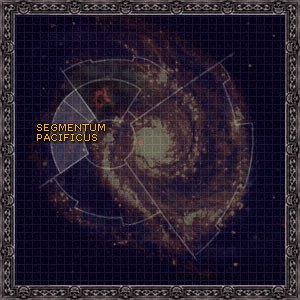 The Segmentum Pacificus, in which Nova Terra lies Artwork © Games Workshop | |
| Segmentum | Segmentum Pacificus |
| Sector | Not recorded in open archives |
| Classification | Civilised world[a] |
| Ruler | Planetary governor (since 975.M35); formerly the Ur-Council |
| Population | Not recorded; described as populous |
| Tithe grade | Not recorded |
| Capital of the west | Early M35 – 975.M35 |
| Known for | The Nova Terra Interregnum; the rival Administratum; the Cataclysm of Souls |
Nova Terra is a populous and wealthy world of the Segmentum Pacificus in the western galaxy. In the 35th millennium its ruling body, the Ur-Council, repudiated the authority of the High Lords of Terra and claimed to govern the worlds of the Segmentum Pacificus in their place. For nearly nine centuries, a period Imperial historians call the Nova Terra Interregnum and the schismatic worlds called the Time of Twin Empires, the Imperium of Mankind had two governments and two Administratums.[1][2]
The Ur-Council fell in the Cataclysm of Souls of 975.M35, when the population of the Pacificus, roused by the Ecclesiarchy, rose against it. Nova Terra has been ruled since then as an ordinary world of the Imperium. Its people remember the Interregnum with a mixture of pride and shame.[1][3]
History
[edit]Before the Interregnum
[edit]The settlement and compliance of Nova Terra are not recorded in open archives. Its name, "New Terra", suggests a colony of the Dark Age of Technology founded from or in honour of Terra, but no record confirms it.[b] By the 34th millennium the world had grown into the effective capital of the western galaxy. The Imperium of that age relied on its sector governors to act on their own judgement, since an answer from Terra might take years to reach the western rim, and Nova Terra's sector lords, merchant houses and Administratum heads met as a council that ruled much of the region in practice.[1]
The Ur-Council
[edit]In the early 35th millennium the council, by then calling itself the Ur-Council, declared that the Senatorum Imperialis had no right to command the west. The exact date of the declaration is not recorded; the earliest datable act of the council as a government is from 257.M35, when the Dark Angels, believing that one of its members was the Fallen Angel Cypher, sent a Ravenwing strike against Nova Terra that took no prisoners.[1][4]
The Ur-Council did not call itself a rebel. It kept the forms of the Imperium, collected tithes, raised Planetary Defence Forces, upheld the Imperial Creed and prayed for the Emperor, while denying the authority of the High Lords. Tithes from the west were paid to Nova Terra, and the astropathic choirs of the segmentum were reorganised under its own officials.[1]
For most of the following centuries the border between the two courts saw raids, sieges and local truces but no decisive battle. The same period saw the Moirae Schism in the Adeptus Mechanicus, the Pale Wasting, and lesser revolts such as the Tellarite Rebellion. In the Hrakon campaign the Dark Angels hunted the despot Obidiah Hrakon, one of the Ur-Council's chief supporters.[1][4]
The Cataclysm of Souls
[edit]Late in the 35th millennium the Adeptus Ministorum began to bind the divided Imperium together as a single theocratic state that transcended the quarrel of the courts. The Ur-Council rejected the Ecclesiarchy's teachings, and the population of the Segmentum Pacificus rose against it. Billions died in the religious wars that followed. In 975.M35 the Ur-Council was overthrown and the authority of the High Lords restored. The Ecclesiarchy emerged with greatly increased power, which led directly to the Age of Apostasy.[1][3]
Later history
[edit]After the Cataclysm Nova Terra's records of the Interregnum were largely destroyed or rewritten by Administratum officials who had reason to portray the Ur-Council as simple rebels.[1] Little is recorded of the world in later millennia. It lies in the Imperium Sanctus, south of the Great Rift, and is not recorded among the worlds lost after 999.M41.[5]
Timeline
[edit]| Date | Event |
|---|---|
| M34 | Nova Terra becomes the effective capital of the west |
| Early M35 | The Ur-Council repudiates the High Lords |
| 257.M35 | Ravenwing raid on Nova Terra |
| M35 | Moirae Schism; Tellarite Rebellion; Hrakon campaign |
| 975.M35 | Cataclysm of Souls; the Ur-Council overthrown |
Geography
[edit]Nova Terra's position within the Segmentum Pacificus is not given in open archives. Imperial accounts describe it as a central world of the western reaches, reachable from much of the segmentum, which allowed it to serve as a capital.[1]
Society
[edit]During the Interregnum Nova Terra was ruled by a council of sector lords, merchant houses and the heads of the local Administratum rather than by a single governor. Its officials maintained a full parallel administration, with its own tithe-rolls and offices. Since 975.M35 it has been governed by a planetary governor under the High Lords.[1]
See also
[edit]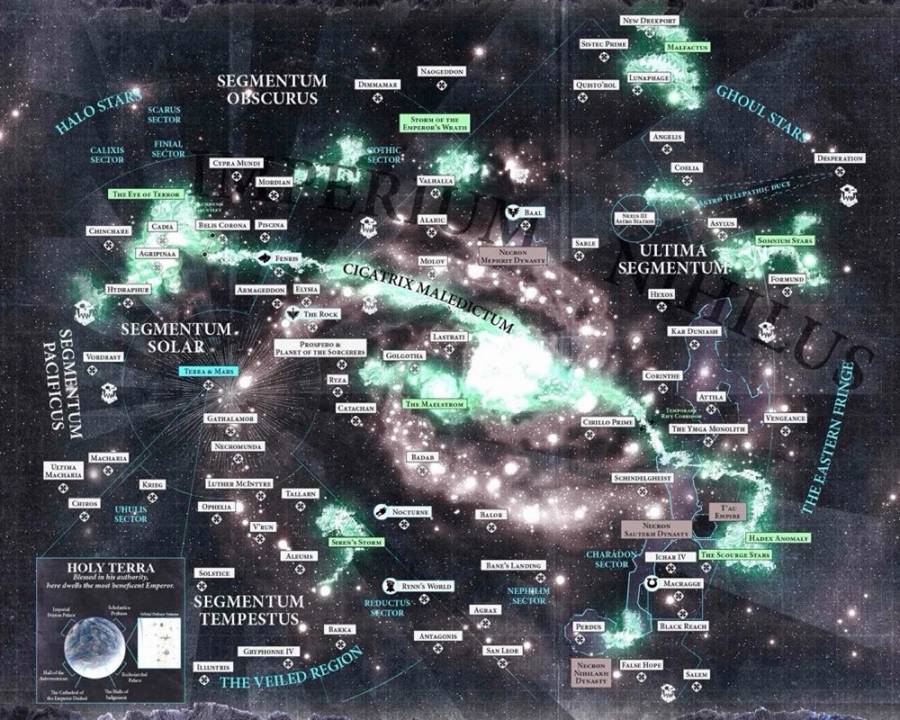

Notes
[edit]References
[edit]- ^ a b c d e f g h i j Warhammer 40,000 Rulebook (8th Edition), pg. 44. Games Workshop.
- ^ Codex: Skitarii (7th Edition), pg. 36. Games Workshop.
- ^ a b Codex: Dark Angels (6th Edition), pg. 23. Games Workshop.
- ^ a b Dataslate: Cypher - Lord of the Fallen (6th Edition), pg. 29. Games Workshop.
- ^ Warhammer 40,000 Rulebook (6th Edition), pg. 170. Games Workshop.