
Emperor's Children
| Emperor's Children III Legion, the Third | |
|---|---|
 Badge of the Emperor's Children Artwork © Games Workshop | |
| Founding | First Founding, 30th millennium, in the closing years of the Unification Wars |
| Legion number | III |
| Primarch | Fulgrim, the Phoenician (found 830.M30) |
| Present leader | Fulgrim, Daemon Primarch of Slaanesh; Lucius the Eternal and other champions lead the warbands |
| Homeworld | Chemos (primarch); recruits from the noble houses of Europa on Terra |
| Realm | Callax, a Daemon World of Slaanesh in the Immaterium; warbands in the Eye of Terror and the Great Rift |
| Flagship | The battle barge Pride of the Emperor (Great Crusade) |
| Allegiance | Loyalist (until 005.M31); Traitor, Chaos (Slaanesh) |
| Colours | Imperial purple and gold; later with the pink of Slaanesh; the first warriors wore storm-cloud grey |
| Legion size | Rebuilt from a small force after a gene-seed disaster; today a scatter of warbands |
| Combat doctrine | Pre-Heresy: perfected combined arms and command of auxiliaries. Now: sonic weapons, duellists and raids for captives |
| Notable battles | |
| Laeran, Isstvan III, Drop Site Massacre, Iydris, Siege of Terra, Battle of Thessala, Extremis Six, Crucible | |
| Notable members | |
| Fulgrim, Eidolon, Fabius Bile, Lucius, Saul Tarvitz, Rylanor | |
The Emperor's Children are the III Legion of the Space Marine Legions. They were the Legion of Fulgrim, the Phoenician, who held that anything worth doing is worth doing perfectly. In the Great Crusade they were counted among the most refined and most exacting of the Emperor's armies, famed for their precision in war, their pride and their intolerance of any failure in themselves. In 005.M31 they followed their primarch into the rebellion of Horus, and in the course of the Horus Heresy they gave themselves to Slaanesh, the Chaos power of excess, so that the search for perfection became a search for sensation without end.[1][2]
The Legion fell in stages that Imperial scholars still dispute. The records point to the world of Laeran, where the Legion's Chief Apothecary and its primarch found something that promised to improve on the work of the Emperor, and to the war of Isstvan III and the Drop Site Massacre, at which the Legion fought with a joy that appalled even its allies. At the Siege of Terra, where it was one of the least disciplined of the Traitor Legions, it earned its present name in Imperial records, the Lords of Profligacy, and thereafter it was broken in the wars between the Traitors in the Eye of Terror. Its remnants survive as scattered warbands, which raid for captives and for new forms of pleasure, and in the 42nd millennium as a Legion reunited in part under Fulgrim himself.[2][3]
The Emperor's Children are among the most hated of the Heretic Astartes. Where the other Traitor Legions kill, the Emperor's Children also collect, torture and display, and Inquisitorial reports of their raids dwell on the number of captives taken alive. After the opening of the Great Rift in 999.M41 their raids multiplied, and the Daemon Primarch, who had been absent for ten thousand years, returned to the material universe.[3]
Legion era
[edit]Origins
[edit]The III Legion was formed in the last years of the Unification Wars, from the finest sons of the noble houses of the continent of Europa on Terra. Europa had fought the Emperor's Thunder Regiments and lost, and its aristocracy offered its youth to the Emperor as tribute and as penance for its defiance. Imperial scholars differ on whether the Legion took its later name from this tithe, which gave the Emperor one son of each great house, or from the primarch's own explanation after he was found. Some houses gave their sons in grudging submission and held them as little more than hostages. Others, such as House Loculus of Komarg, gave their first-born in every generation to the Legion for as long as it lasted.[1]
The early Legion was unlike most of its brothers. The aristocrats who filled its ranks understood how armies were led, and they were used in the late Unification Wars to command the Imperial Army as well as to fight beside it. The Antarctic Clearance, which stands in Army records as a victory of Army Group Antilles, owed its plan to the III Legion, and the Legion took part in the raisings of Nadarin and Jove-Sat II. It was marked by the Emperor with a special honour in the Proximan Rebellion in about 829.M30, where it fought beside him, and the Palatine Aquila, which was the Emperor's own sigil, was granted to it afterwards.[1][4]
The gene-seed disaster
[edit]Within a year of Proxima two blows fell on the Legion in quick succession. In the first, as the Treaty of Mars, signed in 739.M30, opened the gene-laboratories of Luna to the Legions, part of the III Legion's stored gene-seed was sent to the Moon. The ship that carried it was destroyed, crashed or vanished: Imperial accounts give all three, and some blame the surviving cults of the Selenar. In the second, a fast-acting blight of unknown origin struck the gene-seed vaults on Terra itself. The Emperor purged it, but it had already destroyed the whole of the Legion's reserve. Many Legions lost something to the Blight. The Emperor's Children lost everything that could not be recovered from their dead.[1]
The Legion could then grow only by recovering the organs of its fallen, which the nature of battle often prevented, and its numbers fell while its brothers' grew. It might have died within a few decades. Its survival is credited to the discovery of its primarch, which allowed the gene-wrights of the Biotechnical Division to rebuild the reserve from his genome.[1]
The Phoenician
[edit]Fulgrim, the primarch of the III Legion, was found in 830.M30 on the mining world of Chemos, where he had been raised by the Caretakers of the fortress-factory of Callax and had risen to rule its Executives and, in time, the world. When the Emperor came, Fulgrim knelt and offered him his sword. He took command of the Legion with a passion that its officers found frightening. The Legion had been proud before. Under him it became exacting, and its warriors measured themselves against every other Legion and sought to better the best of each. When another Legion was praised, the Emperor's Children took it as a wound. When they exceeded it, they felt contempt. Nothing that they achieved was enough.[1][5]
The Legion's flagship, the battle barge Pride of the Emperor, was among the most beautiful vessels of the Imperial fleet. Fulgrim and his captains collected art, music and the finer weapons of the Crusade, and the Legion's officers held that war was a craft and that the Imperium that would follow it should be one fit for the arts. The primarch's closest friendship was with Ferrus Manus of the Iron Hands, with whom he exchanged a sword and a hammer made by each other's hand. It was also the one that the Heresy would destroy.[5]
Laeran and the first corruption
[edit]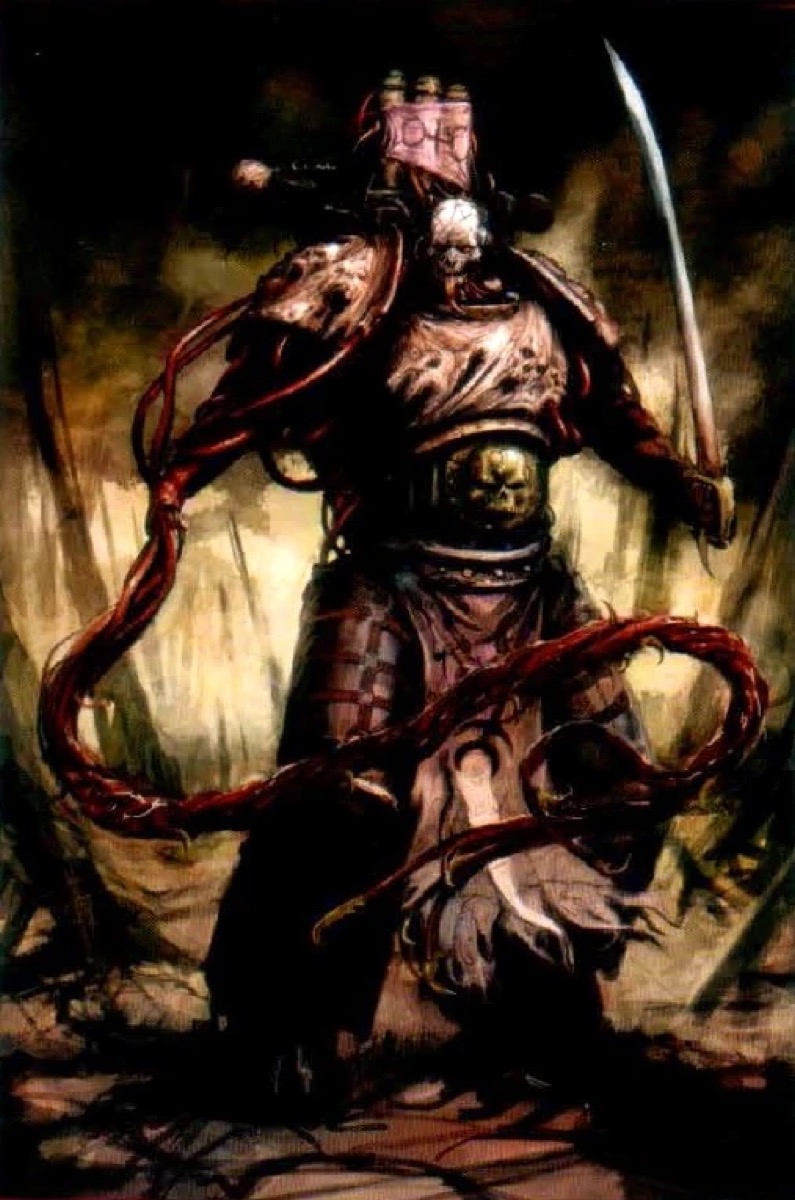
The III Legion's 28th Expedition brought the world of Laeran to compliance as the third in its sequence, in about 000.M31. Its inhabitants, a serpentine species called the Laer, had altered themselves through generations of genetic engineering and lived on floating islands of coral around a vast central temple. The Imperial Truth gave Fulgrim and his Legion no means of understanding what they found. The temple was dedicated to Slaanesh, and at its centre stood a daemon bound into a silver sword. The Legion exterminated the Laer, and Fulgrim claimed the sword.[2][5]
The Chief Apothecary, Fabius, who is better remembered under the name of Bile, examined the bodies of the Laer and told his primarch that their manipulation of their flesh was akin to what the Emperor had done for the Astartes. He suggested, as a heresy of the Mechanicum's own gene-craft, that the Emperor's work was the first step on a road, and that his Legion should walk further. Fulgrim gave him leave. Fabius set up his workshop on a strike cruiser of Lord Commander Eidolon, who consented to be his first patient, and who left it with a new organ that allowed him to scream with the voice of a Laer warrior.[2]
From Laeran the Legion's character shifted. Its warriors sought sensation as well as victory. The Remembrancers who visited the temple and the Legion afterwards recorded music that could not be played without ruining those who heard it, and the Legion's Kakophoni, the sonic specialists who would later become the Noise Marines, began to experiment with sound as a weapon of pain.[5]
Horus Heresy
[edit]Joining the Warmaster
[edit]At Tarsus in 004.M31, the Aeldari Farseer Eldrad Ulthran warned Fulgrim that Horus had been seized by the Ruinous Powers. Fulgrim, who loved Horus, attacked the Aeldari, whom the Legion drove off after slaying a Wraithlord and an Avatar of Khaine. The sword's daemon was by now in the ascendant in the primarch's mind. When Horus told him, in person, that the Emperor had led Humanity to the edge of an abyss of its own making, Fulgrim, who had been taught that to fail is the only sin, did not argue. Horus won him over, and the Legion was among the first to follow the Warmaster.[2][5]
Isstvan III and the Drop Site Massacre
[edit]The Legion was present at Isstvan III in 005.M31. It had been divided, like the Death Guard and the World Eaters, by a purge, and the loyalists of the Legion, among them Captain Saul Tarvitz and the Ancient Rylanor, were gathered on the planet with those of other Legions so that Horus could have them destroyed. Captain Tarvitz, who had learned of the plot, and Captain Solomon Demeter commanded the loyalists of the Legion in their last stand. Captain Lucius of the 13th Company, who envied Tarvitz and wished to prove himself to Eidolon and to the primarch, turned on his old comrades and killed many of them with his own hand. The Legion's traitors were present beside the Death Guard and the World Eaters when the virus bombardment fell. Tarvitz was presumed killed, and Rylanor, a venerable Dreadnought who had been the Legion's Ancient of Rites, was left in the ruins.[2]
At the Drop Site Massacre at Isstvan V in 006.M31, Fulgrim was sent first to the fleet of the Iron Hands, to try to bring Ferrus Manus to the Warmaster's side. He failed, and Fulgrim's Phoenix Guard killed the Morlock Terminators of the Iron Hands at the door of the Anvilarium. On the plain of Urgall he fought and killed his friend, in a duel that began as a contest between equals and ended when the sword of the Laer took control of his arm. Imperial scholars read the hesitation that preceded the blow as the last moment at which Fulgrim could have turned back.[2][5]
Angel Exterminatus
[edit]The Warmaster ordered the Legion to Mars. Fulgrim instead led a fleet of his own to the Iron Warriors' siege at Hydra Cordatus and asked Perturabo to come with him into the Eye of Terror. The two Legions went, guided by an Aeldari seer, to Iydris, a Crone World, and its citadel of Amon ny-shak Kaelis, in whose sepulchre lay the prison of a being the Aeldari called the Angel Exterminatus. Fulgrim reached the chamber and gave himself to Slaanesh. He rose as a four-armed Daemon Prince with a serpent's lower body and wings, like the Laer whom his Legion had destroyed, and his Legion, which had followed him, was Slaanesh's.[2][5]
A band of loyalists from the strike cruiser Sisypheum, survivors of Isstvan V, had followed the fleet into the Eye and fought through the citadel, and the daemon departed from the Laer sword, which passed to Captain Lucius of the 13th Company. Lucius, who had been the Legion's best duellist and its vainest, became one of the principal figures of the Legion's long fall.[2]
The Siege of Terra
[edit]At the Siege of Terra in 014.M31 the Emperor's Children were of little use as a disciplined force. They looted and tortured behind the Palace's outer ramparts and were used, with the Phoenix Guard under Eidolon, as the Warmaster's shock troops against the Saturnine Gate. Fulgrim fought in his old mortal form, killed many of the Imperial Fists and overcame their First Captain, Sigismund, before he met Rogal Dorn, who ran him through. The Phoenician laughed and said that he could not be killed, and when he learned that the Sons of Horus' attack under the Ultimate Wall had failed, he resumed his daemonic shape and left the field.[2][5]
When Horus fell, the Legion fled with the other Traitors into the Eye of Terror, leaving behind it a trail of depopulated worlds.
The Long War
[edit]The Legion Wars
[edit]The Imperial record of the Legion in the centuries that followed is thin, and consists mainly of the reports of those who fought against it. Its supply of slaves and playthings, which it used up in the first decades of its flight, was exhausted. It then raided its fellow Traitors for new ones. The other Legions, who had lost their unifying hand with the death of Horus, turned on one another in the Legion Wars, called by some of their veterans the Slave Wars, and the Emperor's Children were the first to be crushed. Chief Apothecary Fabius, who had gone his own way, took the body of Horus from the Sons of Horus' fortress on Maeleum in an attempt to resurrect the Warmaster. Their raid roused Ezekyle Abaddon from his despair. He struck back at Harmony, the Legion's new throneworld, where Canticle City was destroyed by a hurled derelict vessel, and killed the clone Horus Reborn with the Talon of Horus. The unity of the Legion did not survive. Its warriors broke into warbands, each under its own champion, and Fabius, now the Clone Lord, left them altogether.[2][6]
Thessala and Callax
[edit]In 121.M31, in the Great Scouring, Fulgrim met Roboute Guilliman aboard the Pride of the Emperor in the Battle of Thessala. Guilliman had boarded the flagship with a strike force. The Phoenician, who saw through the Warp the scar on his brother's neck, struck at it with a poisoned blade, and the Ultramarines took the primarch home to Macragge, where he lay in stasis for ten thousand years. Fulgrim then withdrew to a daemon world of Slaanesh in the Warp, which he named Callax after the city of his youth, and which he shaped to resemble Chemos. There, Imperial scholars believe, he spent the following ten thousand years in re-enacting the wars of his world, fighting each again with new strategies in search of the perfect victory, and sometimes letting the enemy win.[5][1]
The Black Crusades
[edit]The warbands took part in the thirteen Black Crusades of the Eye, often as the allies of Abaddon, with whom they traded when it suited both. In the 13th, in 999.M41, Lucius the Eternal led the Legion's warbands and the Traitor Titans of the Riotous Host against Extremis Six. The sonic weapons that Lucius's warriors turned on its starscrapers killed billions, and the regiments of the Astra Militarum that came to avenge them, among them the 352nd Elysian Drop Troops and the 998th Harakoni Warhawks, were destroyed by the host of Slaanesh and by a giant serpentine daemon whom Imperial analysts believe to have been the Daemon Primarch himself.[3]
In the same crusade a Warp-sensitive Imperial agent reported that Fulgrim had sensed the healing of Guilliman at Macragge, and had taken the body of the Arch-Consul to gloat at his brother through its mouth. The same agent reported that the Phoenician told his brother he would meet many temptations, and that any self-satisfaction that he felt would be his doom.[3]
The Second Death of Isstvan III
[edit]The Ancient Rylanor, who had not died at Isstvan III, spent ten thousand years in a collapsed hangar below the Precentor's Palace, beside an unexploded virus bomb. In madness he built a beacon from the remains of the Legion's sonic weapons, and it eventually drew Fulgrim back to the dead world. A party of Thousand Sons also came. When the Daemon Primarch pulled the old Dreadnought from his sarcophagus, Rylanor detonated the bomb, and the Life-eater virus burned across the planet again. The Phoenician reformed himself from the ash, but the Ordo Malleus believes his pride was wounded more than his body.[2][6]
Era Indomitus
[edit]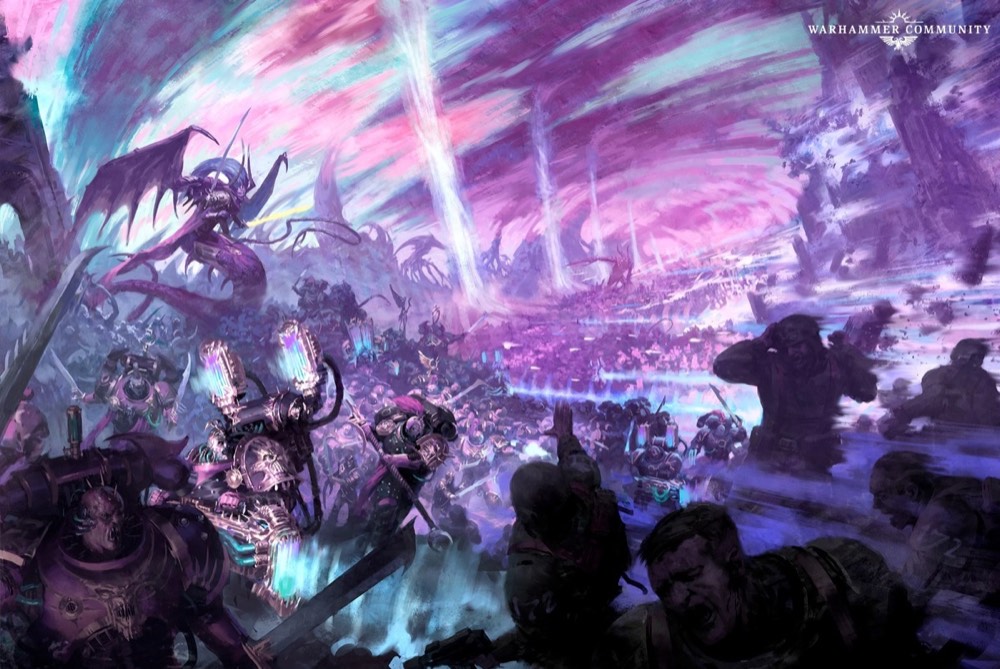
The Great Rift, which opened in 999.M41, was in the view of the Inquisition the best event for the Legion since the Heresy. Slaanesh's strength rose, and the Legion's warbands grew more active than in many centuries. Wherever they strike, the atrocities that they commit are so extreme that the veil between realspace and the Warp is worn thin, and daemons of Slaanesh manifest. The sites of their raids are known afterwards by the madness that lingers in them.[3]
The most significant change has been the return of the primarch. In the early 42nd millennium Fulgrim ended his long exile on Callax and took command of the Legion in person. According to the Ordo Malleus, he told his sons that the Emperor's vision of a united Humanity was flawed, but that in his own hands it would have been magnificent, and that it was Horus, not he, whom the Emperor had left in command after Ullanor. He declared that the Legion would march to Terra and that he would take the throne as the Emperor's true heir. As a trial, he ordered his gene-sons to take Crucible, an industrial world whose people had burned a cult of Chaos at the stake. A detachment of the Black Templars under the Emperor's Champion Johannes Brengar defended it, with a regiment of Cadians.[3][5]
In the same years an Iron Hands detachment, Clan Raukaan under Iron Captain Sind Grolvoch, attacked the Legion on the world of Sabbyst. The Iron Hands wished to avenge Ferrus Manus. Grolvoch, when it became clear that his force would be destroyed, stood alone against the Daemon Primarch to give the refugees time to escape.[3]
Before the opening of the Rift, Fabius Bile succeeded in growing a copy of Fulgrim that was untouched by Slaanesh and sorry for what he had done. Fearing that it would repeat the same mistakes, he delivered it to the Necron Overlord Trazyn the Infinite.[3]
Organisation
[edit]Before the Heresy, the Emperor's Children were organised, like the other Legions, into companies and into the specialist divisions of the Legiones Astartes. They had a strong tradition of command: the Legion's Lord Commanders, who led its companies, were trained as generals, and it was common for a Legion officer to command a mixed force of Army regiments and auxiliaries. The Legion's Phoenix Guard was the primarch's bodyguard, and the Palatine Blades, its elite duellists, were the Legion's own. The Kakophoni were the Legion's sonic specialists.[1][6]
The Legion today has no single order of battle. Each warband is led by a champion, who is called by various titles, among them Lord Exultant, and the best-known are made up of the descendants of the old companies. The sonic specialists survive as the Noise Marines, who carry the sonic blasters and the great sonic cannons of the Legion and who fight to the music of their own weapons. The Legion's duellists, the Infractors and Tormentors, serve its more extreme warbands, and the oldest of the veterans fight in the plate of the Legion's Terminators. A warband commonly includes a number of the Legion's Chaos Cultists, and sometimes the daemons of Slaanesh, as well as a body of slaves that is kept to be fed on.[3][6]
| Name | Role |
|---|---|
| Phoenix Guard | The primarch's bodyguard in Terminator armour, with their own captain, the Phoenix Warden |
| Palatine Blades | Elite duellists of the Great Crusade Legion |
| Kakophoni | Sonic specialists, forerunners of the Noise Marines |
| Noise Marines | Warriors of the cult of sound, who carry sonic weapons |
| Infractors, Tormentors | Warriors of the post-Heresy warbands, trained in agony and display |
| Lord Exultant | The rank of the champions who lead the warbands |
Beliefs and combat doctrine
[edit]The Legion's belief before the Heresy was a belief in excellence. Its warriors were drilled to the point that they could perform a flawless action in any circumstance, and they studied other Legions in order to equal them. They were the Imperium's best at combined operations, where their ability to direct auxiliaries and their knowledge of other armies' needs gave them an advantage that the more insular Legions lacked.[1]
Since the Heresy, the creed has been narrowed to one of sensation. The Legion's warriors believe that they have outgrown their gene-fathers and that the pain and ecstasy that the Emperor's Imperium denies are the means of the next step in transcendence. Their doctrine is one of raids to capture, torture and exhibit, and of sonic assault, in which the Noise Marines and their war machines wear the enemy down with sound before the duellists enter. In practice they are as undisciplined as the Legion was exacting, and their warbands often turn on one another in the aftermath of a battle.[3][6]
Gene-seed
[edit]The Legion's gene-seed, which was nearly extinguished before Fulgrim was found, is among the most mutable of the Legions. Its flesh is now so given to change that it responds to the gifts of Slaanesh, and many of the Legion's older warriors are altered beyond recognition: elongated limbs, additional organs, and in some cases a refinement of the senses that makes the touch of an enemy's blade a pleasure. The Clone Lord's experiments were an extension of this, and he is believed to have created several new strains.[7][6]
Heraldry
[edit]The Legion's badge, a golden eagle's head with one extended wing and talons, is a stylised form of the Palatine Aquila, the Emperor's own sigil, which Fulgrim's Legion was granted. Before the Heresy the Legion wore imperial purple and gold, and no other Legion was then allowed to display the Aquila. After the Heresy the Legion's purple deepened and was joined by the pink and gold of Slaanesh, and each warband added its own mark in place of the laurel.[8]
Notable members
[edit]| Name | Era | Notes |
|---|---|---|
| Fulgrim | Legion and Era Indomitus | Primarch; Daemon Primarch of Slaanesh |
| Eidolon | Legion | Lord Commander; Fabius's first patient; led the Phoenix Guard at Terra |
| Fabius Bile | Legion and after | Chief Apothecary, later the Clone Lord |
| Lucius the Eternal | Legion and after | Captain of the 13th Company; duellist and champion of the Legion |
| Saul Tarvitz | Legion | Loyalist captain killed on Isstvan III |
| Rylanor | Legion and after | Loyalist Ancient; the survivor of Isstvan III who drew Fulgrim back |
Timeline
[edit]| Date | Event |
|---|---|
| 30th millennium | The III Legion is raised from the noble houses of Europa on Terra in the First Founding. |
| c. 829.M30 | The Legion fights beside the Emperor in the Proximan Rebellion and is granted the Palatine Aquila. |
| c. 830.M30 | Loss of the Legion's gene-seed reserve; the Legion begins to dwindle. |
| 830.M30 | Fulgrim is found on Chemos and takes command; the Legion is rebuilt from his genome. |
| c. 000.M31 | Compliance of Laeran; Fulgrim takes the daemon sword of the Laer. |
| 004.M31 | Battle of Tarsus against the Aeldari; Fulgrim pledges himself to Horus. |
| 005.M31 | The Legion's loyalists are betrayed at Isstvan III. |
| 006.M31 | The Drop Site Massacre at Isstvan V; Fulgrim kills Ferrus Manus. |
| M31 | Iydris: Fulgrim becomes a Daemon Prince of Slaanesh beside the Iron Warriors. |
| 014.M31 | The Siege of Terra; Fulgrim duels Rogal Dorn and the Legion flees to the Eye of Terror. |
| After 014.M31 | The Legion Wars; the Legion breaks into warbands. |
| 121.M31 | Battle of Thessala: Fulgrim mortally wounds Roboute Guilliman. |
| 999.M41 | The Thirteenth Black Crusade; Lucius the Eternal's host devastates Extremis Six. The Great Rift opens. |
| Early M42 | Fulgrim leaves Callax and takes personal command of the Legion; the trial of Crucible. |
See also
[edit]

References
[edit]- ^ a b c d e f g h i Codex: Emperor's Children (10th edition). Games Workshop. pp. 12-14, 17, 20, 24-26, 29-31, 84, 88-89. Index Astartes I, "Children of the Emperor: The Emperor's Children Space Marine Legion". Games Workshop.
- ^ a b c d e f g h i j k l McNeill, Graham. Fulgrim (Horus Heresy novel). Black Library. McNeill, Graham. Angel Exterminatus (Horus Heresy novel). Black Library.
- ^ a b c d e f g h i j Codex: Emperor's Children (10th edition). Games Workshop. pp. 12-14, 17, 20, 24-26, 29-31, 84, 88-89. Reynolds, Josh. Fabius Bile: Clonelord (novel). Black Library.
- ^ Index Astartes I, "Children of the Emperor: The Emperor's Children Space Marine Legion". Games Workshop.
- ^ a b c d e f g h i j McNeill, Graham. Fulgrim (Horus Heresy novel). Black Library. McNeill, Graham. Angel Exterminatus (Horus Heresy novel). Black Library.
- ^ a b c d e f Codex Heretic Astartes: Chaos Space Marines (8th edition). Games Workshop. pp. 47-49. Index Astartes I, "Children of the Emperor: The Emperor's Children Space Marine Legion". Games Workshop.
- ^ Codex: Emperor's Children (10th edition). Games Workshop. pp. 12-14, 17, 20, 24-26, 29-31, 84, 88-89.
- ^ Codex: Emperor's Children (10th edition). Games Workshop. pp. 12-14, 17, 20, 24-26, 29-31, 84, 88-89. Index Astartes I, "Children of the Emperor: The Emperor's Children Space Marine Legion". Games Workshop.